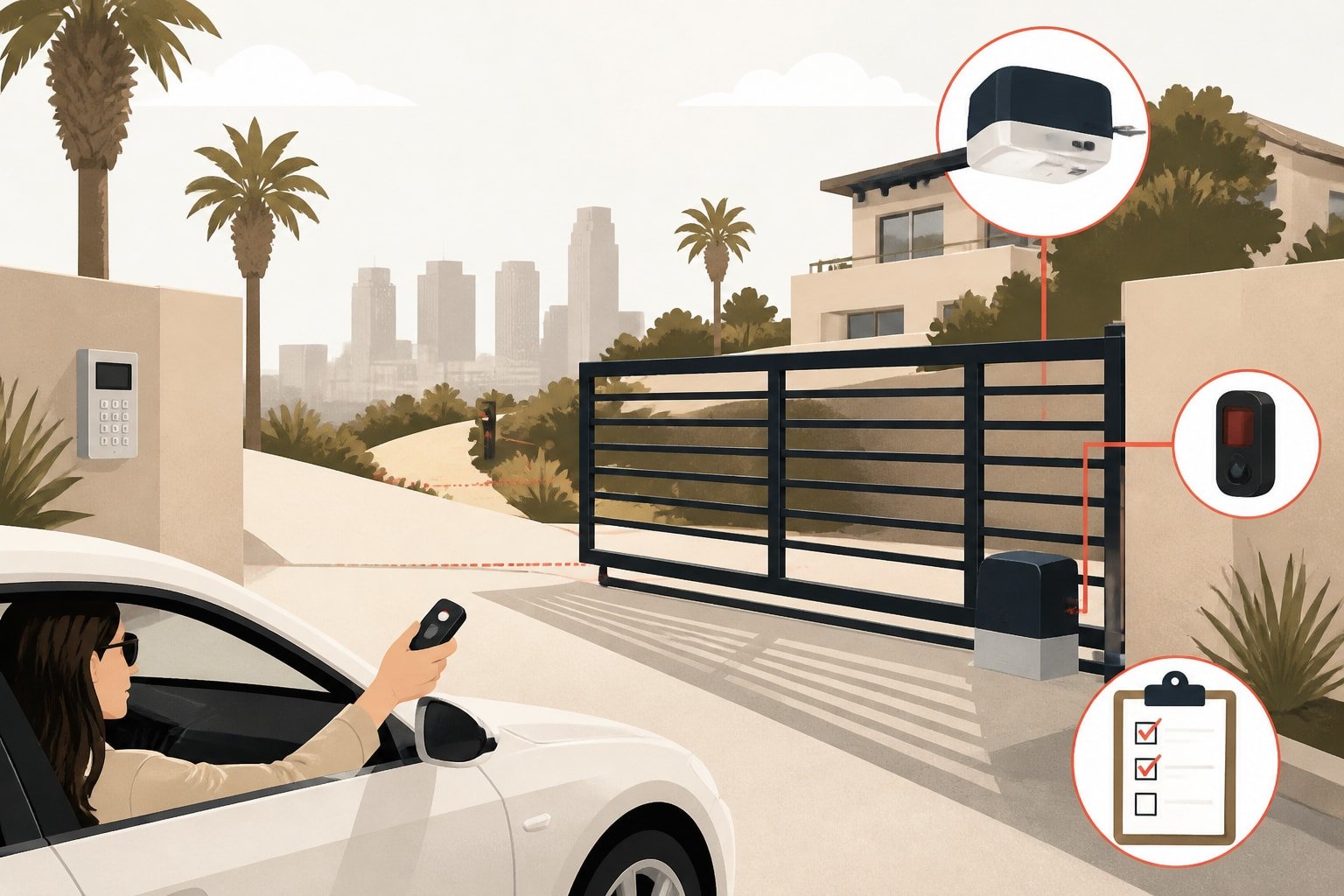
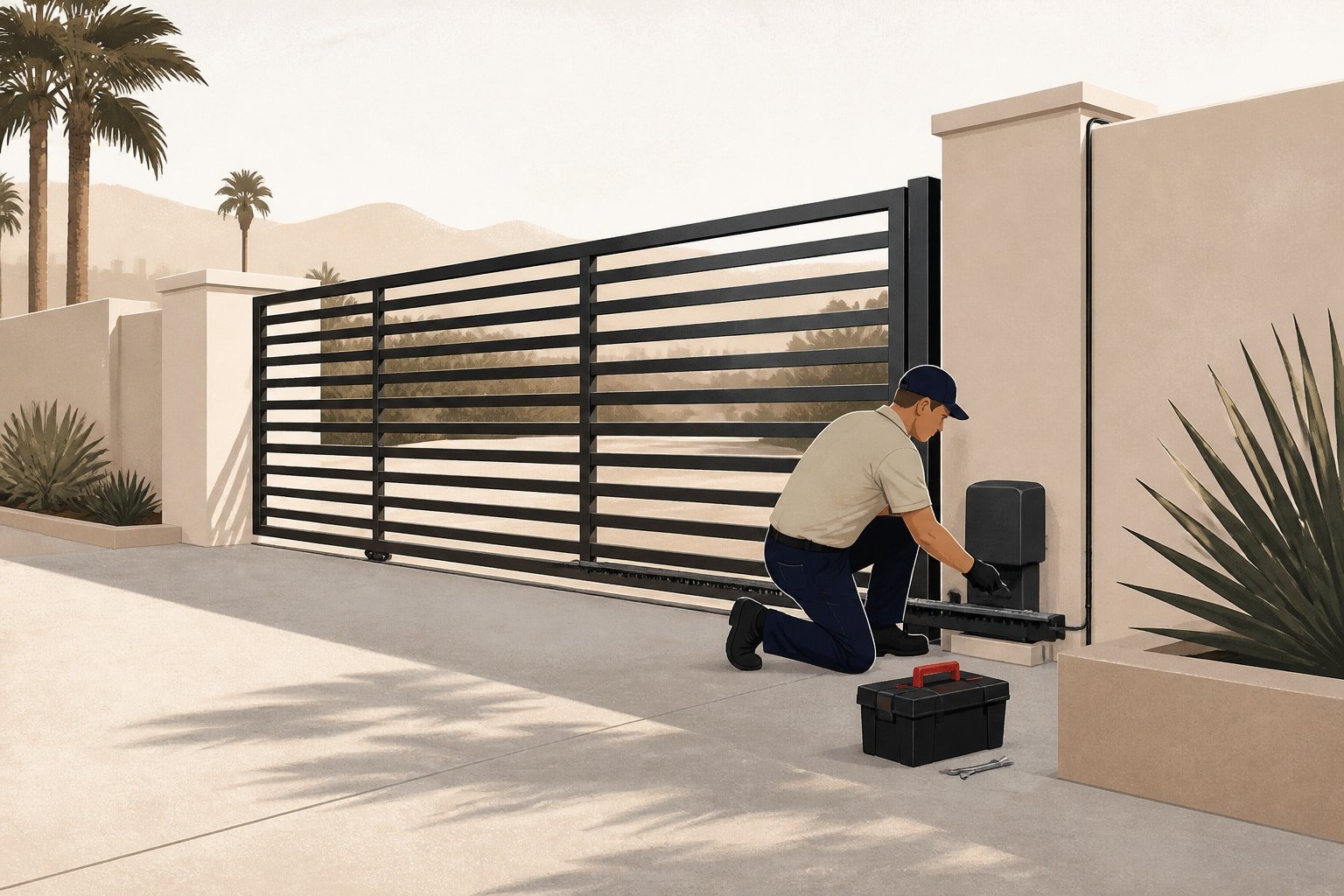

Valley gates are the driveway and entry gates installed at homes and businesses across the San Fernando Valley and the wider Los Angeles basin, and the right choice depends on your driveway layout, your material preference, and how much upkeep you are willing to schedule. Most are automatic, which means a motor, a control board, safety sensors, and a remote system all have to work together every day. When one part fails, the whole gate stops.
This guide explains how to choose among the main gate types, how materials behave in Southern California, what maintenance keeps a gate running, and how to recognize a problem that needs a technician.
What Are Valley Gates and Who Needs Them?
Valley gates are automated or manual vehicle and pedestrian entry gates used on residential driveways, apartment communities, and commercial properties in the Los Angeles Valley areas. They control who enters, keep vehicles and pets contained, and add curb appeal.
For homeowners, a gate is usually about privacy, security, and convenience. For property managers and business owners, it is an access system that tenants, employees, and delivery drivers depend on. A broken gate at a residence is an inconvenience. A broken gate at a commercial property can block deliveries, stall employees, and leave a site unsecured overnight.
Either way, the gate is a mechanical system exposed to sun, dust, and daily use. Choosing well at the start reduces the number of repair calls later.
Types of Valley Gates: Swing, Sliding, and Rolling
The three main designs are swing, sliding, and rolling gates, and the best fit is usually decided by the space beside and in front of your entry. Each type uses a different operator and wears in different ways.
- Swing gates open inward or outward on hinges, in single or double leaf styles. They need clear arc space, which makes them a poor fit for steep or short driveways.
- Sliding gates travel along a track or cantilever beyond the opening. They suit driveways that slope up from the street or lack swing room, but they need a straight run of fence beside the opening. See the options for residential sliding gates and electric sliding gates.
- Rolling gates are a common sight on commercial sites, where the gate rolls along a track and often covers wide openings. A look at an automatic rolling gate shows how that format works.
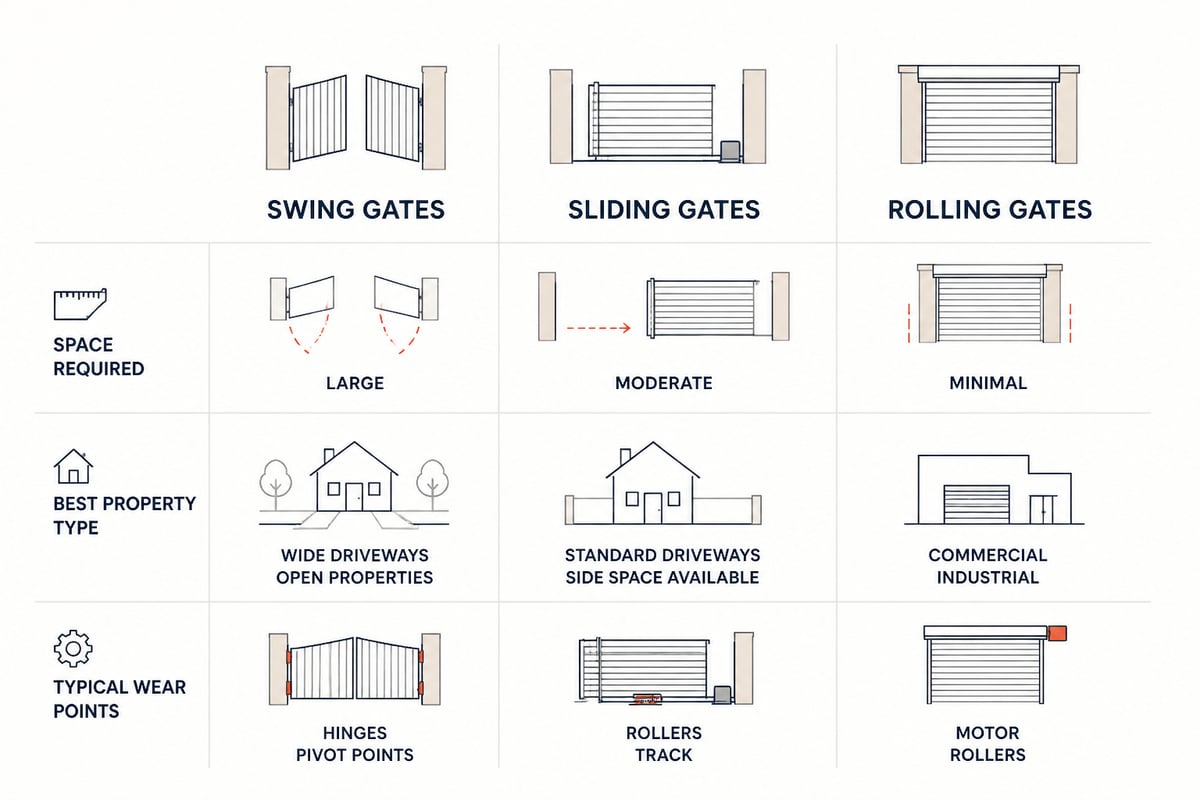
A short checklist helps narrow the choice:
- Measure the clear space inside the property line for a sliding track or a swing arc.
- Note the driveway slope, since steep grades complicate swing gates.
- Count daily cycles. High-traffic commercial entries need heavier-duty operators.
- Decide whether you need pedestrian access separate from the vehicle gate.
Choosing Materials for Southern California Conditions
Iron, aluminum, steel, and wood are the common choices, and each trades appearance, weight, and maintenance differently. Weight matters more than most owners expect, because a heavier gate puts more strain on the operator and hinges or rollers.
| Material | Strengths | Maintenance considerations |
|---|---|---|
| Wrought iron | Strong, classic look, high security | Rust and paint damage need attention; repainting is often recommended every 5 to 7 years |
| Aluminum | Light, corrosion resistant | Lighter weight eases the load on the motor |
| Steel | Durable, solid privacy options | Needs a protective coating to resist rust |
| Wood | Warm appearance, custom designs | Restaining or repainting roughly every 5 to 7 years |
A repaint or restain interval of roughly 5 to 7 years for iron and wood is commonly recommended in Tri-State Gate’s guide to driveway gate materials, which also recommends servicing automated gates twice a year. Los Angeles County's strong sun can fade finishes and dry out wood faster than a mild climate would, so treat those intervals as outer limits rather than targets.
For a broader consumer overview of types, materials, and safety devices, Grand Designs Magazine’s guide to automatic gates is a useful companion read.
Gate Openers and Access Controls
The opener is the component that decides how reliable your gate feels day to day, so it deserves as much attention as the gate leaf itself. Operators differ by gate type, gate weight, and duty cycle.
Common opener and access choices include:
- Swing operators, either arm style or underground, matched to the gate's weight and length.
- Slide operators, which drive a chain or rack along the gate.
- Hidden or low-profile systems, such as a ghost gate opener, for owners who prefer a clean look.
- Residential-grade motors from familiar brands, including Mighty Mule gate openers and LiftMaster electric gate openers.
- Smart controls, which let you open and monitor the gate from a phone.
Match the motor to the actual gate. An undersized operator on a heavy iron gate runs hot, wears gears early, and fails sooner than a properly sized unit.
Safety Features Every Automatic Gate Needs
An automatic gate should detect obstacles and stop or reverse, and any gate that lacks this behavior is a liability. The UK Health and Safety Executive states that powered gates should reverse if they hit a person or object and should use sensors to stop when an obstacle is detected.
Standards bodies also address this area. Standards bodies such as ASTM publish guidance on the hazards of automated gates.
Look for these protections on any gate you own or manage:
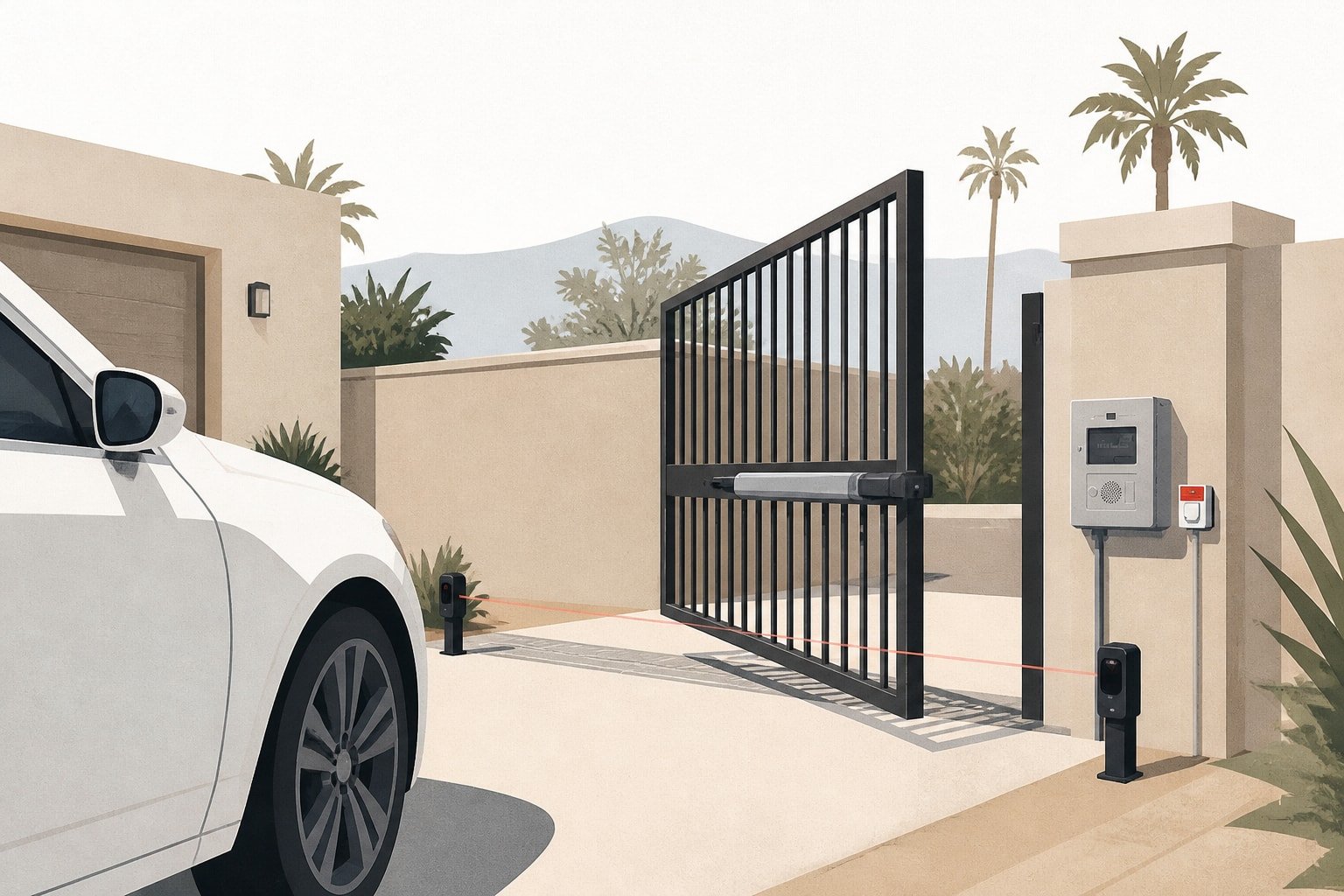
- Photo-eye sensors across the opening
- Edge sensors on the leading edge of the gate
- Reversing logic in the control board
- A manual release that works during a power failure
- Clear signage and, where relevant, a separate pedestrian path
The HSE also says safety devices should be checked regularly and in line with the manufacturer's instructions, as part of planned preventative maintenance. That is the standard worth adopting at a home or a managed property.
A Maintenance Schedule That Prevents Breakdowns
Valley gates last longest when someone inspects them on a fixed schedule instead of waiting for a failure. A spring and fall visit is a practical rhythm for most properties.
Even regulated infrastructure follows this logic. The Federal Railroad Administration notes that automatic railroad-crossing gates require regular maintenance, inspection, and testing under 49 CFR Part 234. Your driveway gate carries less risk than a rail crossing, but the principle holds: automatic gates earn their reliability through routine testing.
Monthly owner checks
- Watch a full open and close cycle and listen for grinding or hesitation.
- Test the photo-eye by waving an object in the path while the gate closes.
- Clear debris, leaves, and gravel from tracks and hinge areas.
- Confirm remotes and keypads respond on the first try.
Twice-yearly professional service
- Lubricate moving parts as the manufacturer specifies
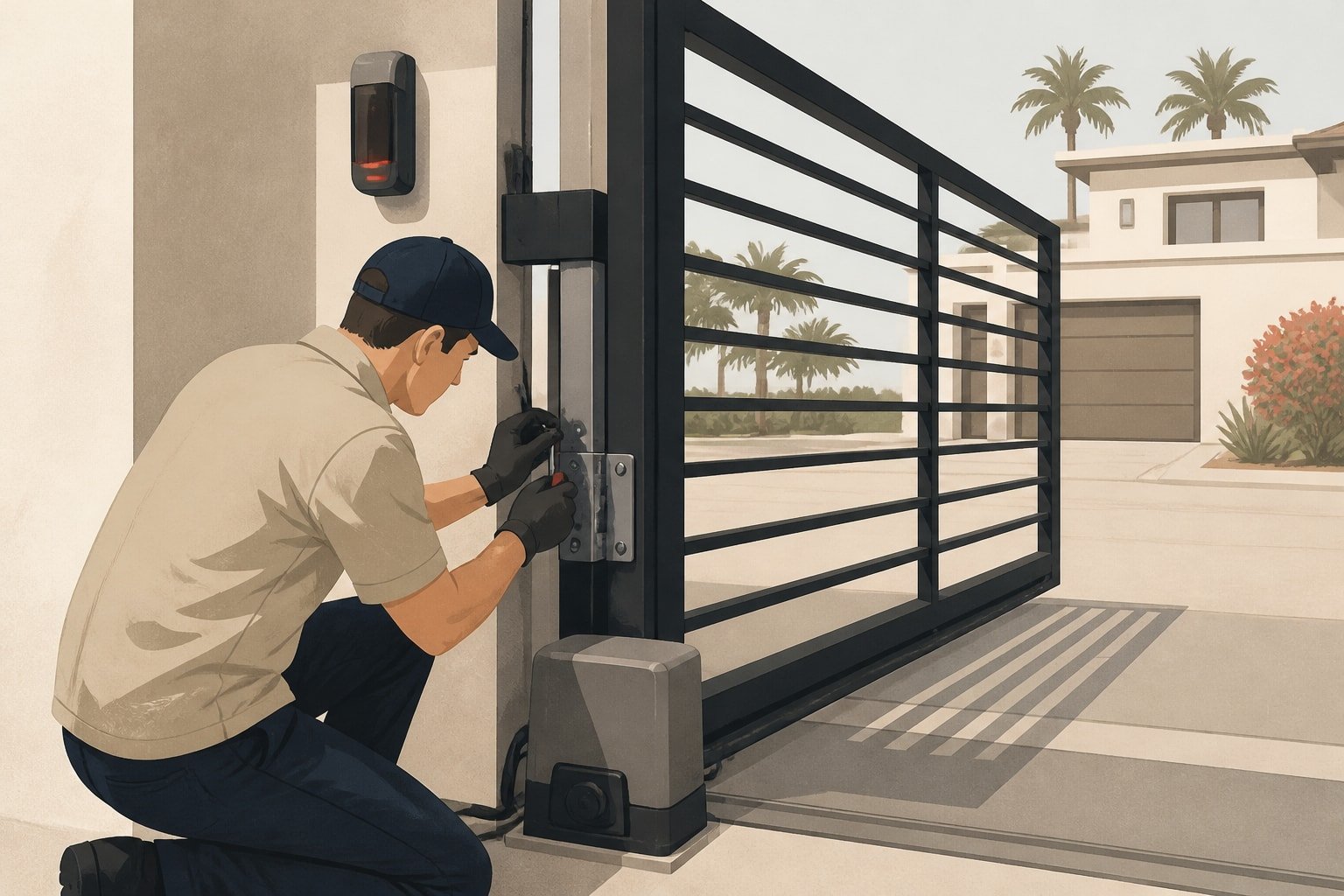
- Inspect rollers, hinges, chains, and rack alignment
- Test safety sensors and reversing force
- Check wiring, limit switches, and the control board
- Test backup battery or manual release function
Keep a simple log of dates and findings. A log helps a property manager spot patterns, such as a gate that repeatedly loses its limit setting, before they turn into emergency calls.
Warning Signs That Your Gate Needs Repair
A gate that is slow, noisy, stuck, or inconsistent is telling you something is wearing out, and early attention is cheaper than a full failure. Common symptoms include:
- The gate stops partway or reverses for no clear reason
- Remotes work only at close range
- Loud grinding, clicking, or humming from the motor
- Visible sag, a bent track, or a gate that rubs the ground
- The gate does not respond at all after a power surge or storm
Some of these are simple, such as a misaligned sensor or a weak remote battery. Others point to a failing motor, damaged gears, or a burned control board. Safety-sensor faults should not be ignored or bypassed, because a gate that no longer detects obstacles can injure someone.
If your gate is stuck open overnight or will not open for a delivery, that is an emergency in practice, even if it is not dangerous.
When to Repair and When to Replace
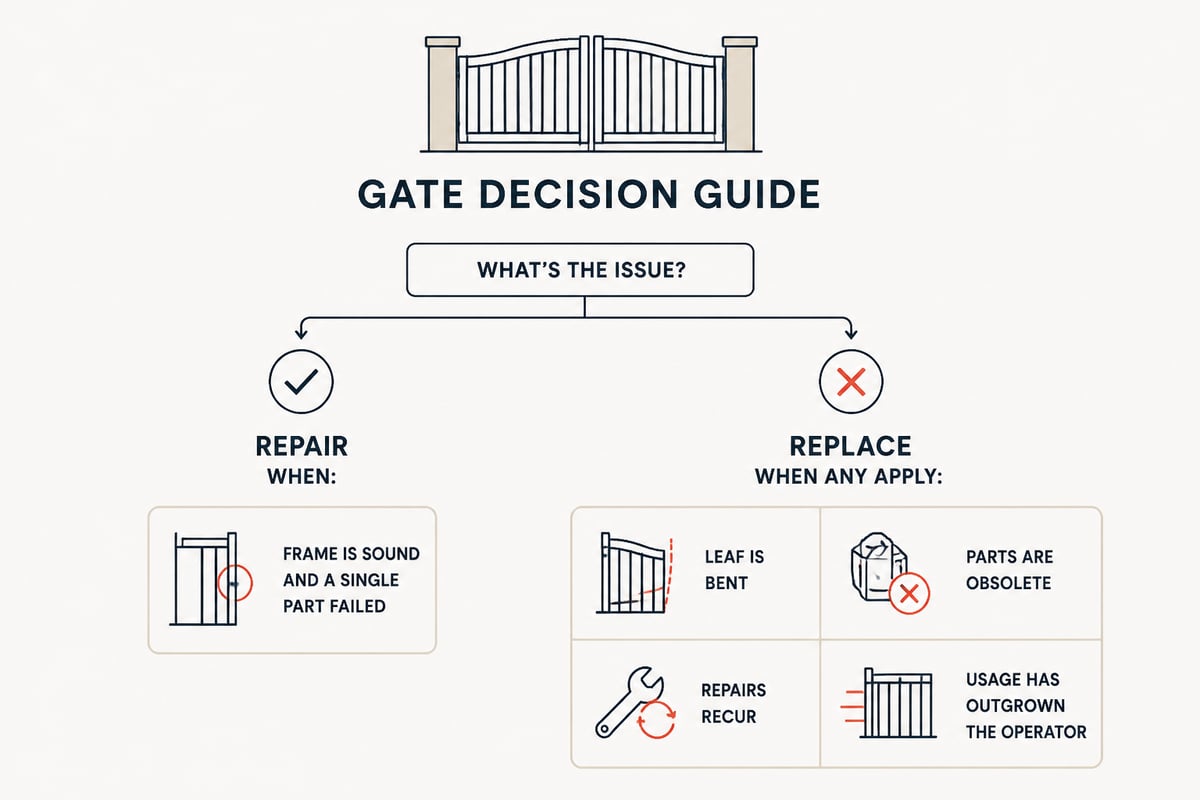
Repair makes sense when the gate structure is sound and the failed part is a discrete component, while replacement becomes the better value when problems keep stacking up. A new sensor, a control board, or a motor on a gate that is otherwise square and solid is a straightforward repair.
Consider replacement or a major upgrade when:
- The gate leaf is bent, rusted through, or no longer hangs true.
- The operator is obsolete and parts are hard to find.
- Repairs are happening several times a year.
- Your usage has grown, such as more tenants or more deliveries, and the original operator is undersized.
For multi-unit properties and business sites, commercial automatic gates and commercial security gates are built for higher cycle counts than residential units.
Working With a Local Gate Repair Company
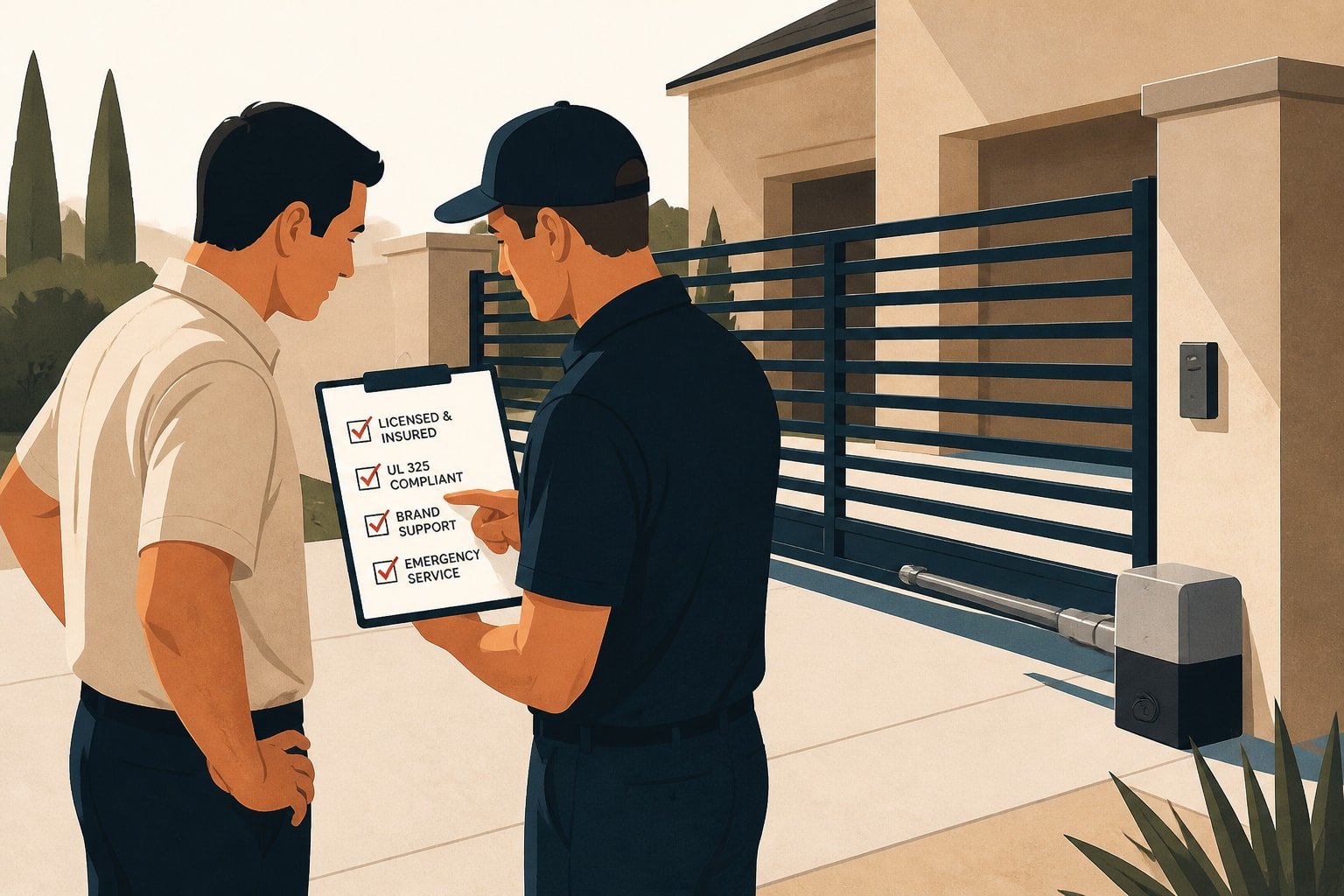
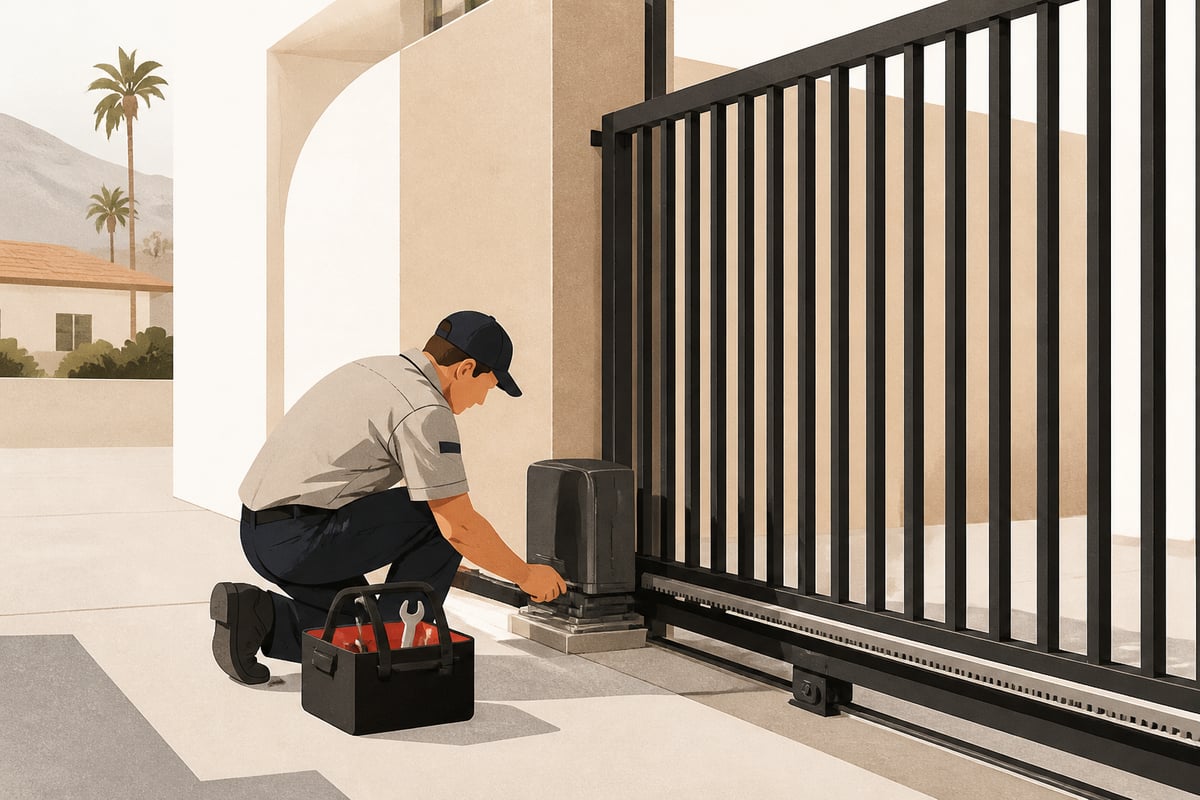
A local technician who knows Los Angeles County properties can diagnose problems faster and keep a gate in service longer than a distant provider. Gates & Garage Door Express Inc. is a family-owned company with 21 years in business, licensed and insured under CSLB 1081161, and it works on all major gate and garage door brands. For a stopped or misbehaving gate, its electric gate repair service is the most direct starting point.
When comparing providers, ask:
- Are they licensed and insured, and can you verify the license number?
- Do they offer same-day, on-site service and after-hours emergency help?
- Do they work on your gate's brand?
- What happens if you are not satisfied with the repair?
Gates & Garage Door Express Inc. provides same-day on-site service, emergency service at no extra charge including after hours, and free rework if you are not satisfied with the outcome. It also offers senior and veteran discounts. You can read feedback from past customers on the testimonials page, which reflects over 500 reviews on major accredited sites.
Questions to Ask Before You Buy or Hire
A few direct questions at the start prevent most disappointments with valley gates, whether you are buying new or hiring for repairs. Ask about the following before you commit:
- Duty rating: Is the operator rated for the number of cycles your property will generate?
- Safety equipment: Which sensors and reversing features come with the gate, and are they tested at handover?
- Backup access: How does the gate open during a power outage?
- Service plan: What does a recommended maintenance visit include, and how often?
- Documentation: Will you receive manuals, remote programming instructions, and wiring information?
Property managers should also confirm who responds to after-hours failures and how quickly, since a blocked entrance affects every resident or employee at once. Written answers to these questions make future repairs and handovers far simpler.
Start by watching your gate through one full open and close cycle today, and note any hesitation, noise, or sensor failure so you can describe it accurately. If something is off, or you want a twice-yearly service plan in place, Gates & Garage Door Express Inc. is a family-owned Los Angeles gate and garage door company that can send a technician the same day, so Call (818) 873-7687 to describe the problem and get a visit scheduled. For a stopped gate, its electric gate repair service is the quickest route back to a working entry.