
A Mighty Mule gate motor is the operator arm or drive unit that opens and closes a residential swing or slide gate, usually powered by a battery that a solar panel or plug-in transformer keeps charged. Most problems come down to four causes: a weak battery, a misaligned gate, a blocked safety sensor, or an incorrect travel or force setting. This guide explains how the system is set up, how to diagnose the common failures, and when a repair is better left to a licensed technician.
How a Mighty Mule Gate Motor Works
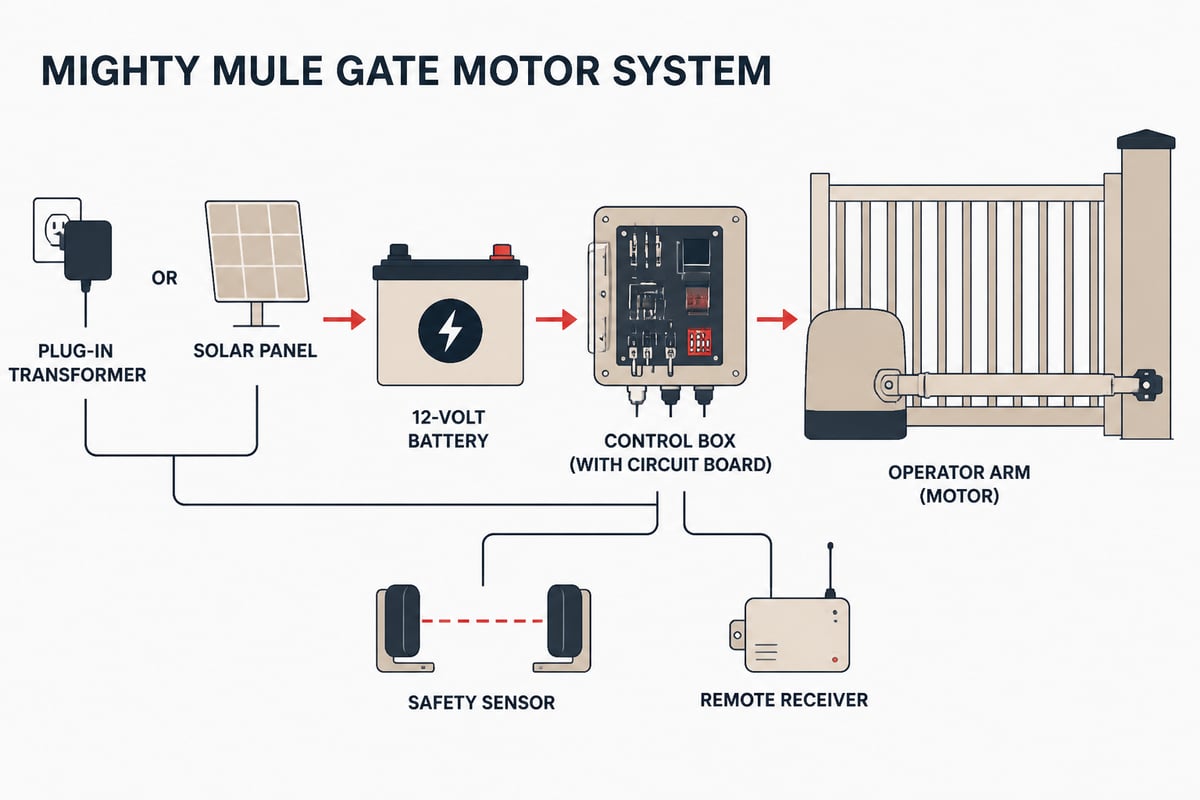
A Mighty Mule gate motor converts stored battery power into the push and pull that moves your gate, controlled by a small circuit board that senses resistance and listens for a remote signal.
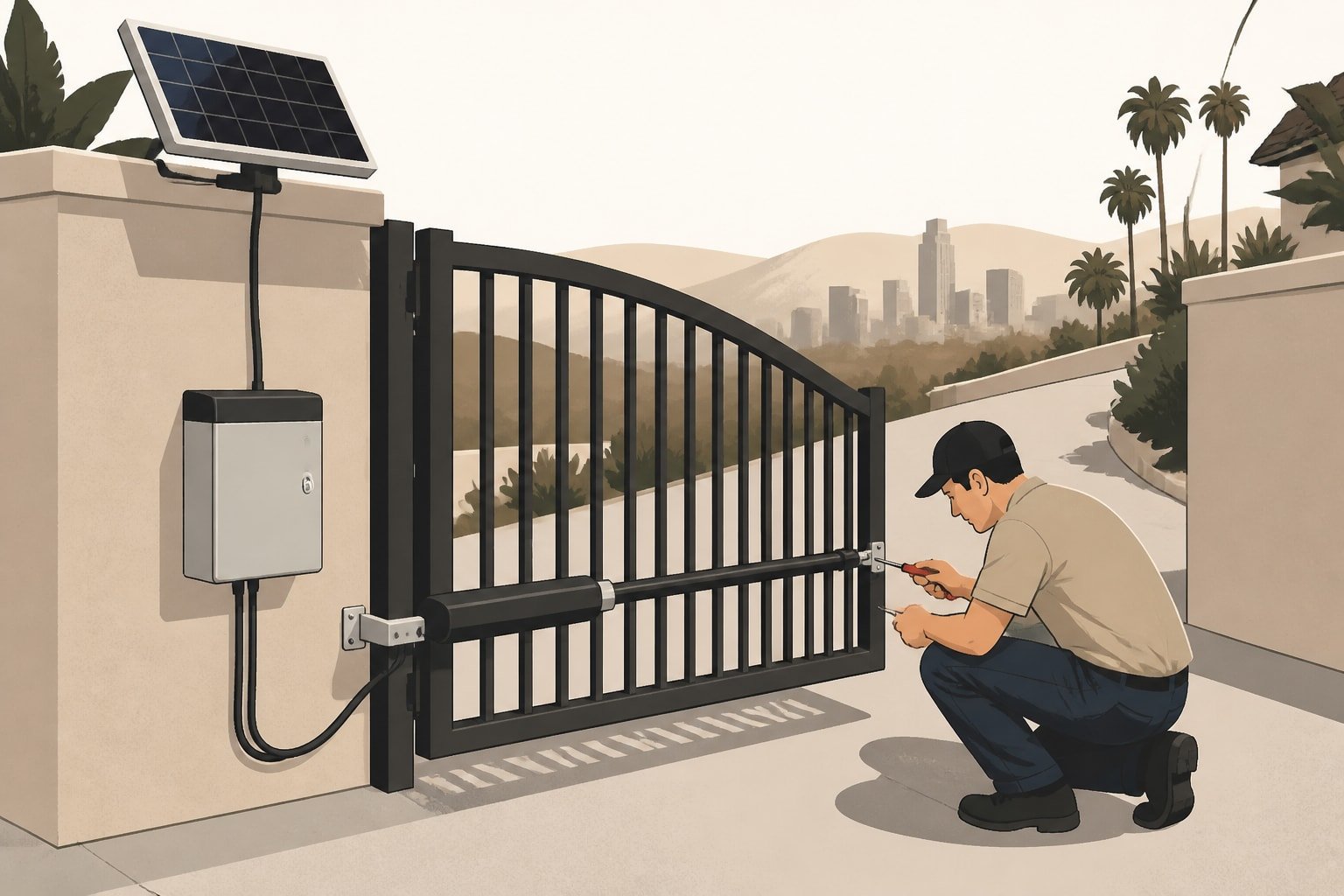
The system has four core parts:
- The operator arm or drive unit. On swing gates, a linear arm extends and retracts. On slide gates, a drive unit turns a wheel or pinion to move the gate along its track.
- The control box. This houses the circuit board, the receiver for your remotes and keypads, and the settings for travel distance and obstruction sensitivity.
- The battery. A rechargeable 12-volt battery stores power so the gate keeps working during cloudy weather or a power outage.
- The charging source. Either a solar panel or a plug-in transformer keeps the battery topped up.
Because the motor runs on low-voltage battery power, it is designed for light to medium residential gates. Heavy wrought iron, oversized panels, or gates that see constant commercial traffic often need a heavier-duty operator. If you are comparing options, our page on a Mighty Mule electric gate opener outlines what these units are built to handle.
Setting Up a Mighty Mule Gate Motor Step by Step
A correct setup depends on a gate that swings or slides freely by hand before any motor is attached, followed by proper bracket placement, wiring, and limit programming.
Mighty Mule offers interactive 3D installation instructions through its BILT app, with audio, text, and animated guidance, and the app also lets owners register products and access warranties, according to the Mighty Mule Help Center. Following the manufacturer's sequence matters, because a small bracket error causes problems that look like motor failure later.
- Test the gate first. Push the gate open and closed by hand. It should move smoothly with one hand. Binding hinges, a sagging frame, or a dragging bottom edge must be corrected before installation.
- Mount the operator. Attach the post bracket and gate bracket at the heights and distances in the installation manual. Even a one-inch deviation can cause uneven force or incomplete closing.
- Place the control box and charger. Mount the control box within reach of the operator cable. Position a solar panel where it receives direct sun for most of the day, away from tree shade.
- Connect the battery and safety devices. Wire the battery, the charging source, and any photo eyes or reflectors. Check polarity before powering on.
- Program travel limits and force. Set how far the gate opens and closes, then adjust obstruction sensitivity so the gate reverses on contact without false stops.
- Pair remotes and keypads. Follow the manual's learn-mode procedure for each transmitter.
- Run safety checks. Place an object in the gate path and confirm it reverses. Test the photo eyes by breaking the beam during closing.
Gates in Los Angeles County face a few local conditions worth planning around: intense sun that fades and cracks cables, marine moisture near the coast, and dust in the valleys. Sealing cable entries and choosing a shade-free panel location prevents many callbacks.
If you would rather have the unit installed and calibrated for you, our team handles gate motor installation across Los Angeles County.
How Long Should a Mighty Mule Battery Last?
A Mighty Mule battery's lifespan depends on charging quality, gate weight, climate, and how often the gate cycles.
Specific replacement intervals vary by model and use, so check your manual for the figure that applies to your unit. In practice, batteries on these systems tend to age faster when they are chronically undercharged. A solar panel in shade, a loose charging connection, or a gate that is too heavy for the motor forces the battery to work harder and discharge deeper each cycle.
Signs the battery is near the end of its life:
- The gate opens slowly or stops partway through a cycle.
- The gate works in the morning but fails after several cycles in a row.
- The control board lights flicker or show a low-battery indication.
- A freshly charged battery still drops quickly under load.
To confirm, measure the battery voltage with a multimeter after the gate has rested and again while it moves. A battery that reads near full at rest but collapses under load is worn out and should be replaced. Replacing the battery is a straightforward job, but the cause of early failure should be corrected at the same time or the new battery will follow the same path.
Why Your Gate Opens but Won't Close
A gate that opens but will not close almost always has an obstruction signal, a safety sensor fault, or a force and travel setting that is stopping the close cycle.
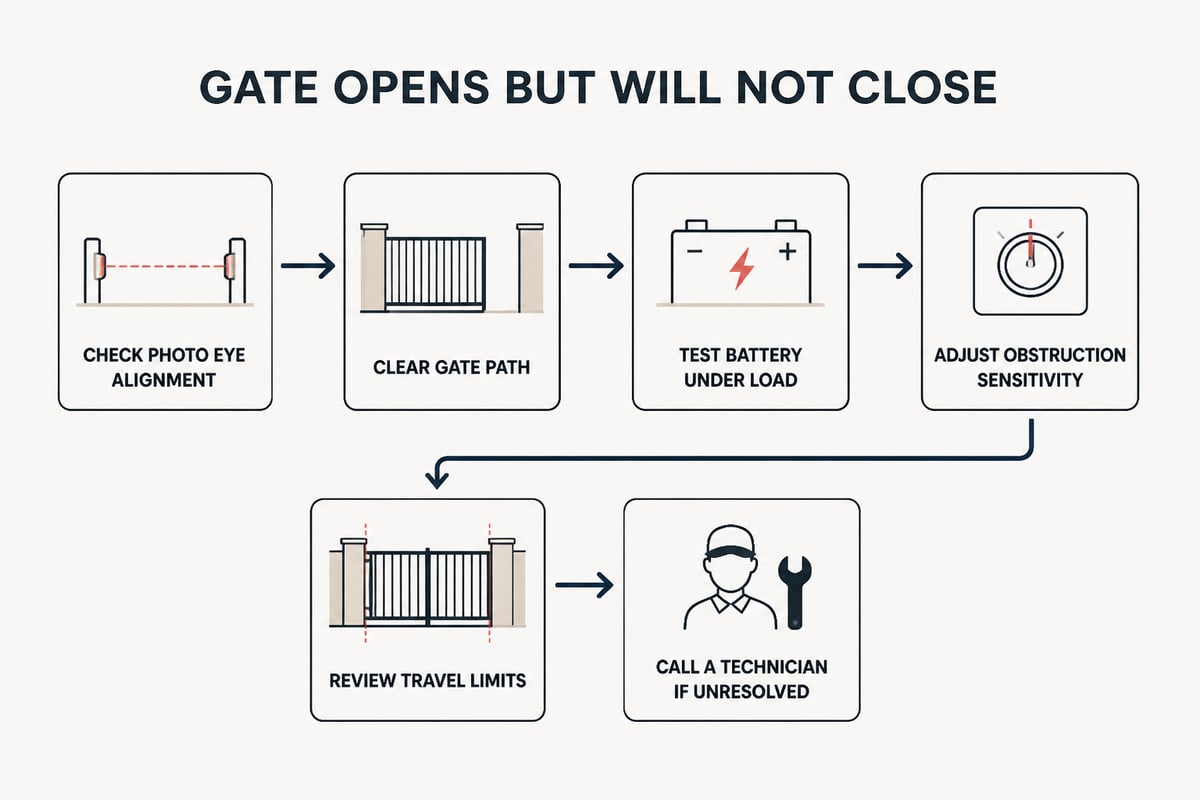
This is the most common complaint on automatic gates, and the closing direction is more sensitive than the opening direction for a reason. Safety standards require the gate to detect obstacles while closing, so a blocked or misaligned sensor can stop it from ever completing the cycle. Work through these checks in order:
- Photo eyes and reflectors. Clean the lenses and confirm they face each other without obstruction. Spider webs, a leaning post, or a shifted bracket can break the beam.
- Gate path. Look for debris, a raised paver, or a stone in the track or sweep area.
- Obstruction sensitivity. If the force setting is too low, normal friction reads as an obstacle and the gate reverses. Increase sensitivity slightly and retest.
- Travel limits. A close limit set too tight can cause the gate to stop short and reverse.
- Mechanical resistance. A stiff hinge or a sagging gate adds load that the board interprets as a blockage.
- Battery strength. A weak battery may have enough power to open against gravity-assisted movement but not enough to complete a full close.
If the gate still refuses to close after these checks, the circuit board or a sensor wire may be at fault. That is the point where guesswork starts to cost more than a service call. Our Mighty Mule gate opener repair service diagnoses these faults on-site.
Troubleshooting Other Common Mighty Mule Gate Motor Problems
Most other faults trace back to power, signal, or alignment, and a short symptom-to-cause check usually points to the right fix.
| Symptom | Likely cause | First thing to check |
|---|---|---|
| Gate does not move at all | Dead battery or no charge | Battery voltage and charger connection |
| Motor hums but gate stays put | Binding gate or stripped drive | Move the gate by hand for resistance |
| Remote works only up close | Weak remote battery or antenna issue | Replace remote battery, check antenna placement |
| Gate stops midway | Low battery or sensitivity too high | Voltage under load and force setting |
| Gate reverses on its own | Obstruction detection or loose bracket | Brackets, track, and sensitivity |
| Gate opens on its own | Radio interference or stuck input | Remote buttons, keypad, and nearby signals |
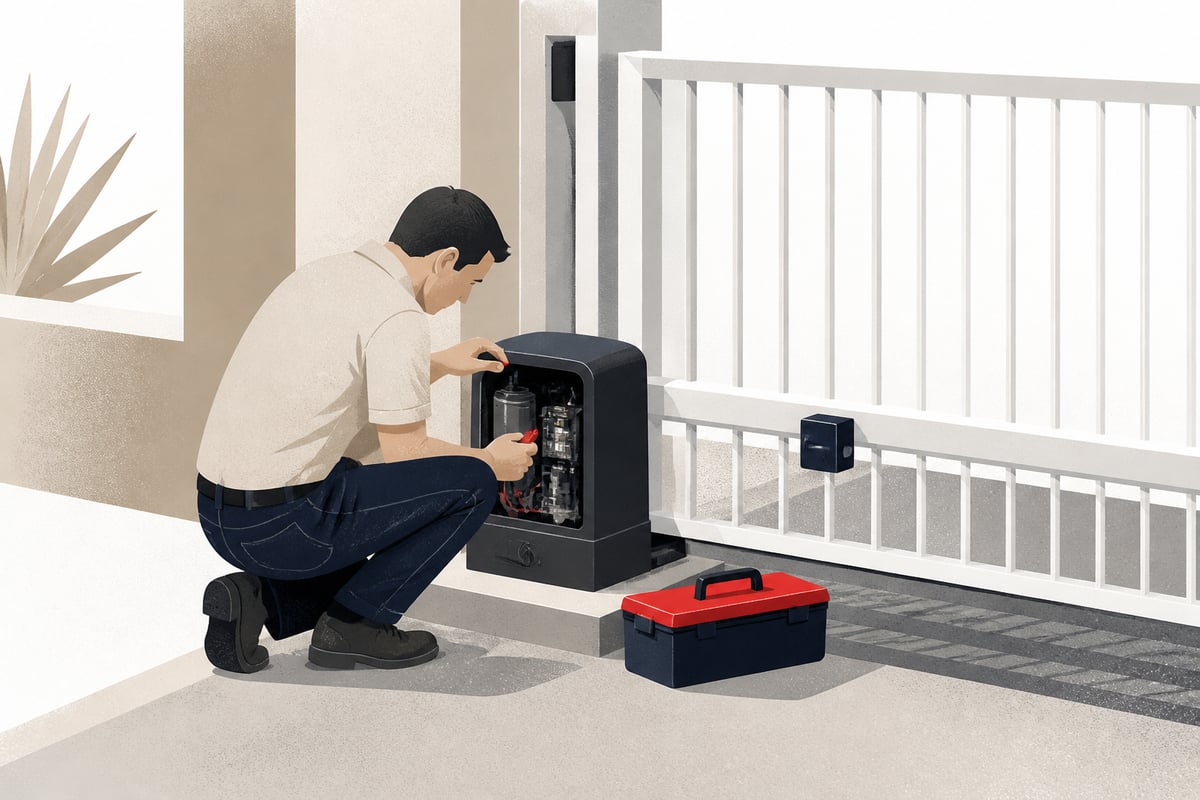
A few additional notes help with diagnosis. If the remote stops working entirely, first confirm the gate responds to a wired button or keypad. That separates a transmitter problem from a control board problem. If the gate worked normally until a storm or power surge, inspect for water inside the control box and look for scorched contacts.
Mighty Mule also states that its technical support can provide virtual setup and troubleshooting guidance using TechSee, and the Help Center lists support hours of Monday through Friday, 9 a.m. to 7 p.m. EST, per the Mighty Mule Help Center. That channel is useful for owners comfortable working with the manual. For hands-on repair, our team covers automatic gate motor repair throughout the area.
Safety Requirements for Gate Operators
Any automatic gate must include entrapment protection, and gate operators in the United States are covered by the ANSI/UL 325 safety standard.
The U.S. Consumer Product Safety Commission notes that its staff participates in the UL Standards Technical Panel for ANSI/UL 325, which covers door, drapery, gate, louver, and window operators and systems, as described on the CPSC Garage Door Operators and Gate Operators page. In practical terms, a working gate should have entrapment protection, such as an obstruction sensor or a photo eye or edge sensor.
For homeowners and property managers, the takeaway is simple. Do not bypass a photo eye to stop a nuisance fault, and do not raise obstruction force beyond what the gate needs to move. A gate that has lost its safety response is a liability, particularly on properties with children, pets, or public foot traffic.
Is a Mighty Mule a Good Gate Opener for Los Angeles Properties?
A Mighty Mule is a reasonable choice for lightweight to medium residential gates, but it is not the right tool for heavy, high-traffic, or commercial entrances.
Its strengths are easy installation, battery backup that keeps working during outages, and solar charging that avoids trenching power to a remote gate. Those features suit many single-family driveways in Los Angeles County, where sunshine is plentiful and gates are often set back from the house.
The limits are just as clear:
- Gate weight and length. Heavy iron or solid-panel gates can overwork a light-duty operator and shorten battery and motor life.
- Usage volume. Apartment complexes, offices, and shared access points cycle a gate many times a day, which calls for a commercial-grade operator and a hardwired supply.
- Slope and wind. Hillside driveways and gusty canyon locations add load that residential models may struggle with.
Property managers weighing an upgrade should compare cycle counts and gate weight against the operator's rating before buying. Our overview on whether to add a motor to an electric gate covers the factors that matter, and our commercial gate services address higher-traffic sites.
Which Motor Is Used in a Sliding Gate?
Sliding gates are typically driven by a DC or AC electric motor connected to a gear reduction system that turns a pinion against a rack, or a drive wheel against a rail.
Residential slide operators, including Mighty Mule models, generally use a low-voltage DC motor paired with a battery, since it supplies steady torque at low speed and supports battery backup. Heavier commercial slide gates often use an AC induction motor with a hardwired supply for continuous duty.
When a slide gate stalls, the motor is rarely the first suspect. Track debris, worn rollers, a bent rail, or a loose rack usually cause the extra resistance that makes the motor labor. Cleaning and lubricating the track and checking roller wear solves many slide gate complaints before any motor work is needed. If the motor itself has failed, a technician can test windings, gear wear, and the control board to decide between repair and replacement. Details on our gate opener motor options are available if replacement is the better path.
When to Repair and When to Call a Professional
Simple adjustments such as cleaning sensors, tightening brackets, and replacing a remote battery are reasonable to attempt, while wiring faults, board failures, and structural gate issues call for a licensed technician.
Call for professional help when you see any of the following:
- Repeated battery failure after replacement
- Burn marks, melted insulation, or water inside the control box
- A gate that has sagged or twisted and no longer moves freely
- Safety sensors that fail even after cleaning and realignment
- A gate that moves unpredictably, which is a safety hazard
Gates & Garage Door Express Inc. is a family-owned business with 21 years in business, licensed and insured under CSLB 1081161, and it works on all major gate brands. We offer same-day, on-site service, with emergency service available at no extra charge, including after hours. Senior and veteran discounts are available, and if you are not satisfied with the outcome, we offer free rework. For a stuck or unresponsive gate, our electric gate repair service is the most direct way to get a technician on site.
Owners who need compatible hardware can also browse gate motors for sale before scheduling a visit, so the right unit is on hand if a replacement turns out to be necessary.
FAQ
How often should a Mighty Mule gate motor be serviced?
An annual inspection is a sound baseline for most residential systems. A technician checks battery voltage, bracket tightness, hinge or track condition, safety sensor function, and charging performance. Gates in coastal or high-use settings may benefit from a check every six months.
Can a Mighty Mule gate motor work during a power outage?
Yes, because it runs on a rechargeable battery rather than directly on household power. The gate continues to operate until the battery is drained, and a solar panel can keep it charged without grid power. A battery in poor condition shortens that backup time considerably.
Why does my remote work inconsistently?
Weak remote batteries, a poorly placed receiver antenna, and radio interference are the most common causes. Replace the remote battery first, then check that the antenna is clear of metal and the control box is properly sealed. If the keypad or wired button works normally, the issue lies with the transmitter or receiver.
If your gate is stuck or acting up today, start by clearing the sensor path, checking the battery voltage, and confirming the gate moves freely by hand. When those checks do not solve it, the team at Gates & Garage Door Express Inc. can diagnose the fault on-site, and our electric gate repair service covers Mighty Mule systems and other major brands across Los Angeles County. Call (818) 873-7687 to schedule a same-day visit with Gates & Garage Door Express Inc.