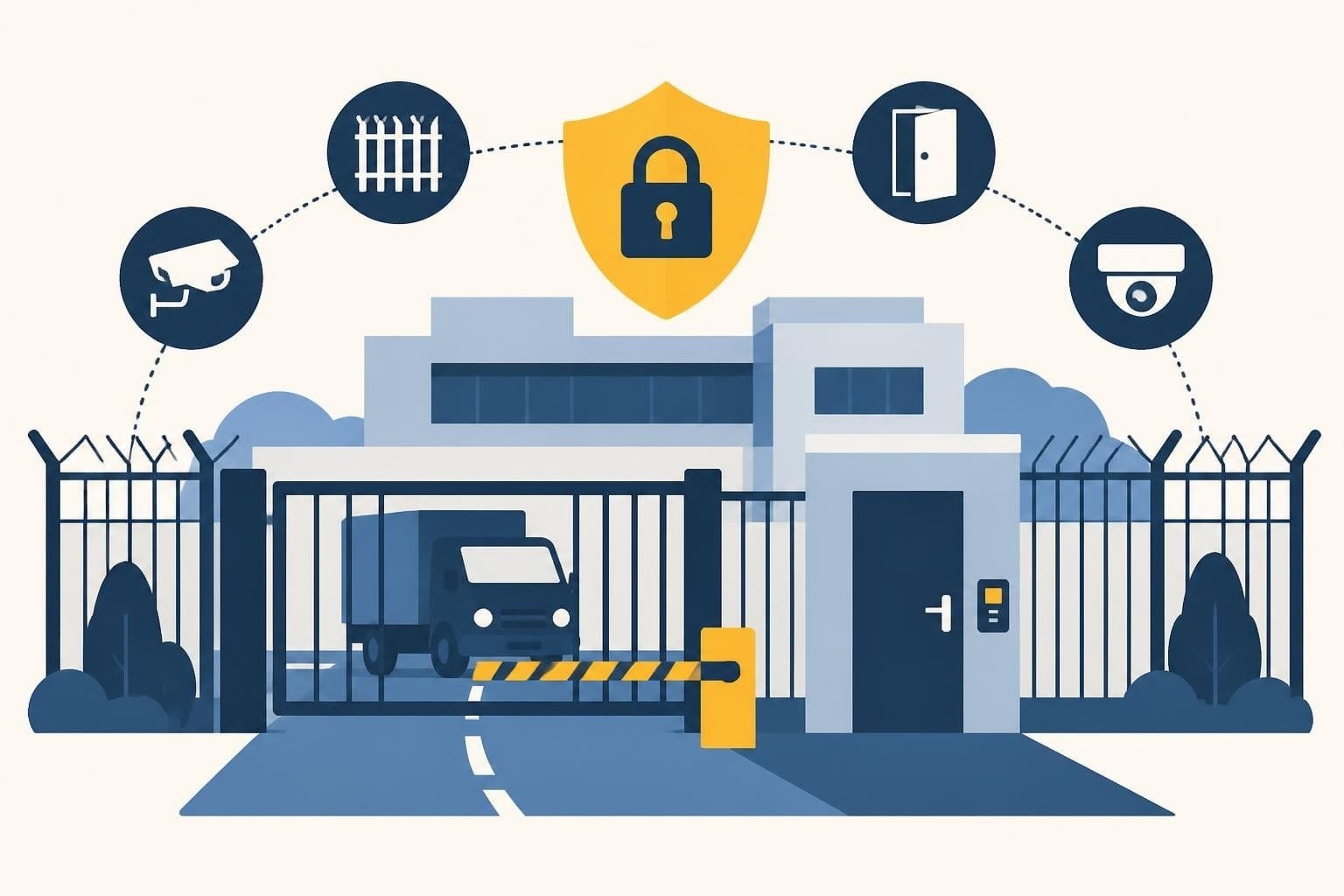

Property protection in 2026 demands a multi-layered approach that combines physical barriers with intelligent access control systems. A comprehensive security door gate and fence strategy creates concentric layers of protection, deterring unauthorized access while maintaining convenient entry for authorized personnel and visitors. Whether protecting residential estates, commercial facilities, or industrial complexes, understanding how these three components work together determines the effectiveness of your entire security posture. This guide explores the critical considerations for selecting, installing, and maintaining integrated perimeter security systems that meet both safety standards and operational requirements.
Understanding the Security Triad: Doors, Gates, and Fences
The relationship between doors, gates, and fences forms the foundation of perimeter security architecture. Each element serves distinct yet complementary functions that together create a cohesive defense strategy.
Fencing establishes the primary perimeter, defining property boundaries and creating a psychological deterrent. Modern security fencing extends beyond simple chain-link barriers to include anti-climb mesh, welded steel panels, and reinforced concrete walls. The fence height, material composition, and foundation depth all contribute to resistance against forced entry attempts.
Gates control vehicular and pedestrian access points within the fence line. These critical junctures represent the most vulnerable elements of any perimeter system, requiring robust construction and reliable automation systems. According to research from ASIS International on access control systems, integrating physical barriers with electronic access management significantly enhances overall security effectiveness.
Security doors provide the final layer at building entry points. These hardened portals withstand forced entry attempts while managing human traffic flow during normal operations. The door material, frame reinforcement, locking mechanisms, and hinge protection all factor into the overall security rating.
Material Selection Criteria
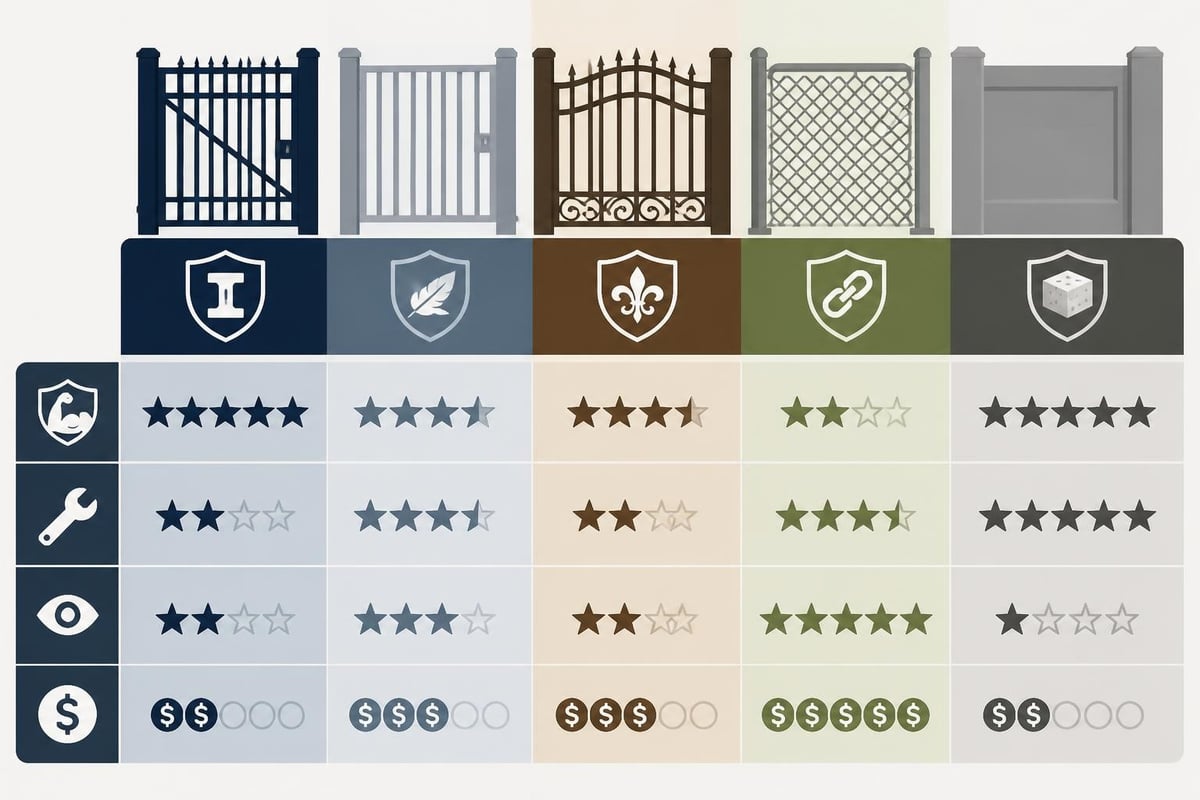
Choosing appropriate materials for your security door gate and fence system requires balancing multiple performance factors:
| Material | Durability | Maintenance | Visibility | Cost |
|---|---|---|---|---|
| Steel | Excellent | Moderate | Limited | High |
| Aluminum | Good | Low | Moderate | Moderate |
| Wrought Iron | Excellent | High | Good | Very High |
| Chain Link with Privacy Slats | Fair | Low | Limited | Low |
| Reinforced Concrete | Outstanding | Very Low | None | Very High |
Steel remains the dominant choice for high-security applications due to its strength-to-weight ratio and weldability. Galvanized and powder-coated finishes extend service life in harsh environmental conditions. Aluminum offers corrosion resistance for coastal installations but provides less structural integrity against determined intrusion attempts.
Design Principles for Integrated Perimeter Protection
Effective security door gate and fence design follows established principles that maximize deterrence while minimizing operational friction. The security industry recognizes several fundamental concepts that guide system architecture.
Defense in depth requires multiple independent security layers. If an intruder bypasses the outer fence, they must still overcome gates and doors before reaching protected assets. Each layer employs different security mechanisms, preventing a single point of failure from compromising the entire system.
Clear zone maintenance ensures 10-15 feet of unobstructed space on both sides of the fence line. This practice eliminates climbing aids, improves surveillance camera effectiveness, and enables security personnel to detect intrusion attempts. Landscaping within clear zones should use low-growth plants that provide no concealment.
The CISA Vehicle Incident Prevention guide emphasizes passive barrier integration for facilities facing vehicle-borne threats. Bollards, reinforced gates, and strategic hardscaping prevent vehicles from breaching pedestrian areas or building facades.
Access Point Optimization
Every gate and door represents a potential security vulnerability requiring careful planning:
- Minimize access points to reduce the number of locations requiring surveillance and control
- Separate vehicle and pedestrian traffic to enable different security protocols for each
- Design for emergency egress ensuring life safety codes override access restrictions during emergencies
- Implement clear sight lines at gates to prevent blind spots where threats can hide
- Plan for peak traffic flows to prevent queuing that creates security gaps
Professional installation services, such as electric gate repair specialists, understand these design principles and can optimize gate placement for both security and operational efficiency. Their expertise ensures compliance with local building codes while maintaining the security integrity of the overall system.
Automation and Access Control Integration
Modern security door gate and fence systems leverage automation technology to enhance both security and convenience. Electronic access control transforms static barriers into intelligent checkpoints that log entries, restrict access by schedule, and integrate with broader security management platforms.
Gate Automation Technologies
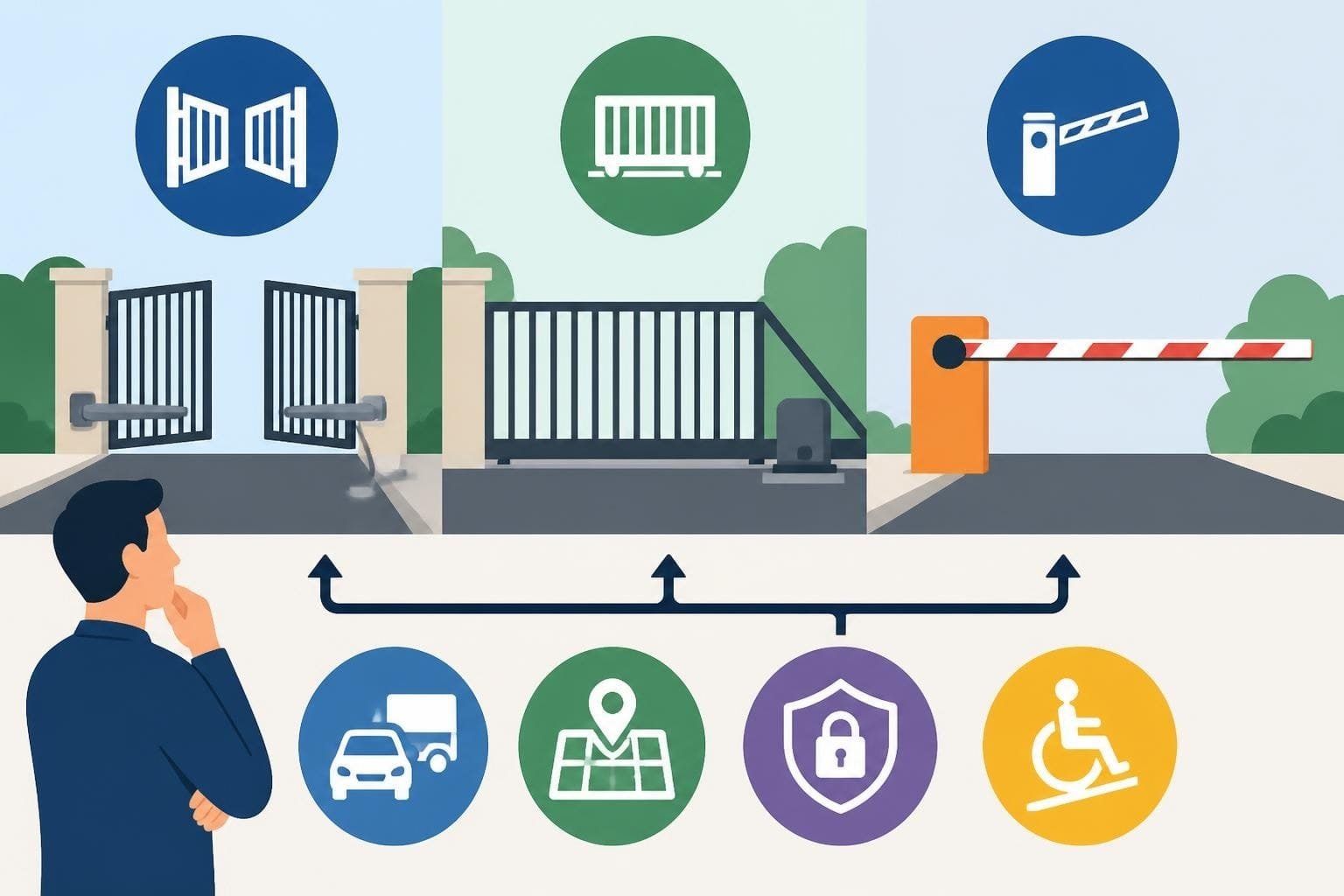
Automated gates employ various actuator types depending on the gate style and traffic volume:
- Swing gate operators use articulating arms for gates that open inward or outward
- Slide gate systems move gates laterally along the fence line, ideal for limited clearance areas
- Overhead track mechanisms lift gates vertically for industrial applications
- Hydraulic actuators provide superior force for heavy-duty installations
- Electromechanical drives offer quieter operation for residential environments
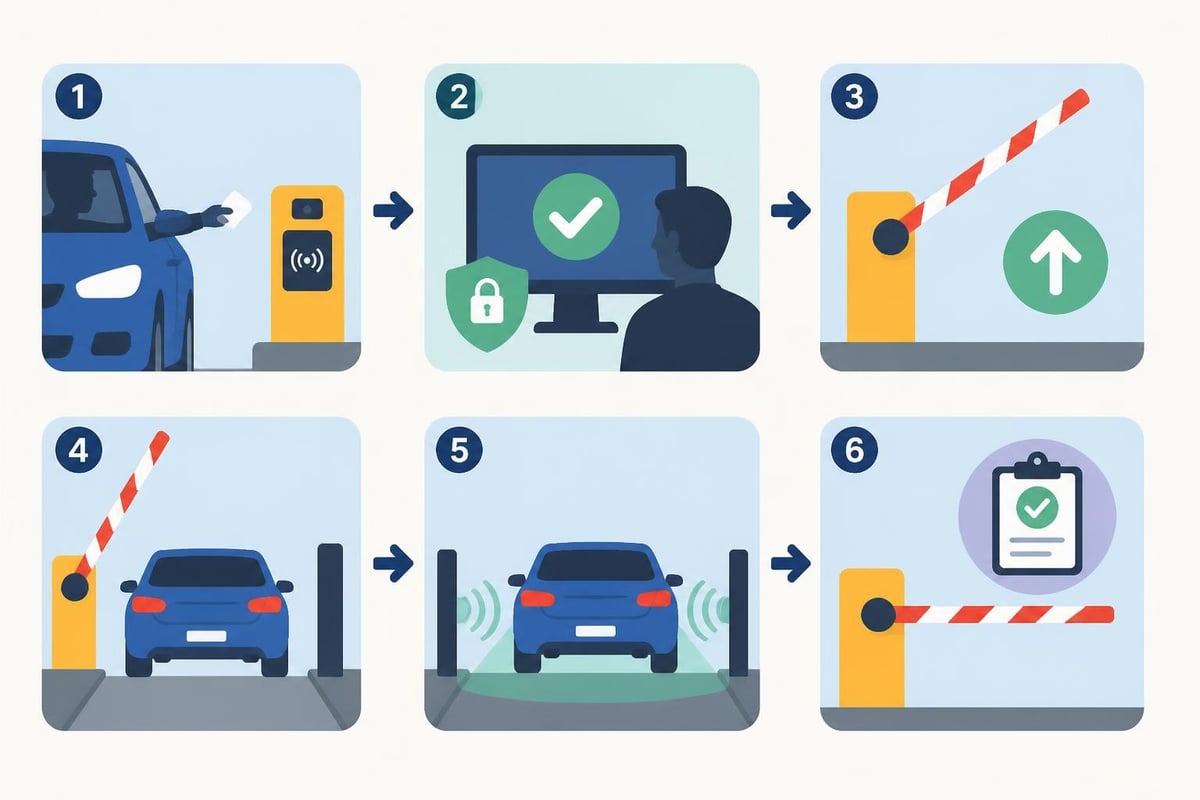
Safety features must comply with UL 325 standards for automatic gate operators. NIST references to gate safety standards outline requirements for entrapment prevention, including photo-eye sensors, edge sensors, and emergency stop mechanisms. These safety systems prevent injury while maintaining security functions.
Access credentials range from traditional keypads and card readers to biometric scanners and license plate recognition systems. Multi-factor authentication combines something you have (credential card) with something you know (PIN code) for enhanced security at critical access points.
| Access Method | Security Level | Convenience | Cost | Audit Trail |
|---|---|---|---|---|
| Keypad PIN | Moderate | High | Low | Limited |
| Proximity Card | Good | Very High | Moderate | Detailed |
| Biometric | Excellent | Moderate | High | Comprehensive |
| License Plate Recognition | Good | Very High | High | Comprehensive |
| Mobile Credential | Good | Very High | Moderate | Detailed |
Installation Best Practices and Compliance
Proper installation determines whether a security door gate and fence system meets its design specifications. Professional installation addresses foundation preparation, structural reinforcement, electrical integration, and regulatory compliance.
Foundation and Structural Requirements
Fence posts require concrete footings that extend below the frost line to prevent seasonal heaving. High-security fences use deeper footings with anti-tunneling barriers extending 2-3 feet below grade. Gate posts carry additional load from the gate weight and operator mechanism, necessitating larger footings with reinforcement bars.
The ProtectUK guidance on fences and gates recommends specific anti-lift measures for gate hinges and mounting hardware. These include concealed hinge pins, welded hinge plates, and bottom guide tracks that prevent gate removal even if mounting bolts are compromised.
Door frames require anchoring into structural members rather than veneer materials. Security-rated doors specify minimum frame gauge thickness and reinforcement schedules. The strike plate location demands particular attention, as this point absorbs the greatest force during forced entry attempts.
Electrical and Control System Integration
Automated gates and electronic locks require reliable power delivery and backup systems:
- Dedicated circuit breakers sized appropriately for operator current draw
- Conduit protection for wiring running underground or through exposed areas
- Surge protection safeguarding control boards from lightning and grid fluctuations
- Battery backup systems maintaining operation during power outages
- Solar panel options for remote locations lacking grid access
Control panels should mount in weatherproof enclosures within secured areas. Network-connected systems require cyber security measures including firewalls, encrypted communications, and regular firmware updates to prevent unauthorized access through digital means.
When addressing maintenance needs, property owners in Los Angeles can reference resources on what to do when garage doors malfunction for troubleshooting guidance that applies to automated gates as well, since both systems share similar operator mechanisms and safety features.
Maintenance Programs for Sustained Performance
A comprehensive security door gate and fence system requires ongoing maintenance to ensure reliable operation and sustained security performance. Neglected systems develop vulnerabilities that compromise the entire security investment.
Scheduled Inspection Protocols
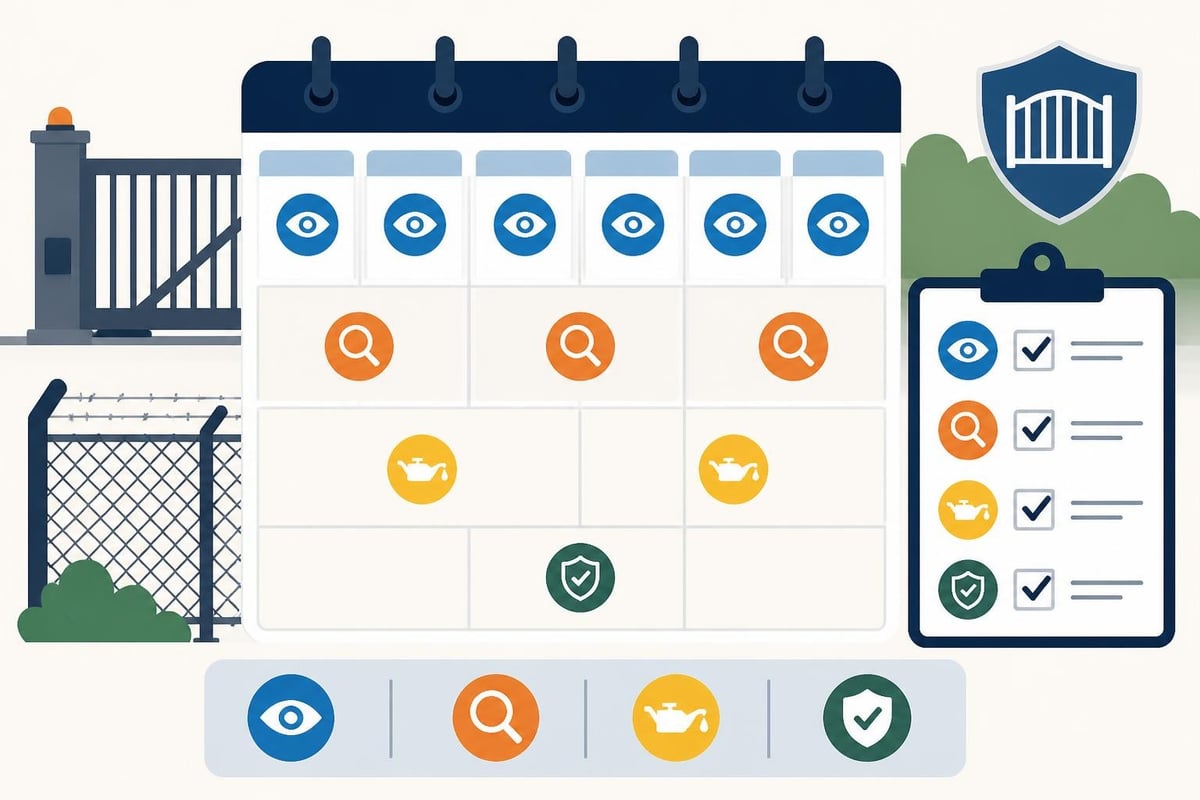
Professional maintenance programs follow structured inspection schedules that catch developing issues before they cause failures. Monthly visual inspections identify obvious damage, while quarterly detailed inspections examine mechanical and electrical components.
Monthly inspection checklist:
- Visual examination of fence fabric for cuts, damage, or displacement
- Gate alignment and smooth operation through full travel range
- Photo-eye sensor cleanliness and alignment
- Lock mechanism function and bolt engagement
- Hinge and pivot point lubrication
- Control panel indicator lights and error codes
Quarterly detailed inspection:
- Fence post stability and foundation integrity
- Gate operator mounting bolt torque verification
- Battery backup system load testing
- Access control reader function with all credential types
- Safety system response time measurement
- Weatherseal condition on doors and gate closures
The SANS Institute physical security management policy template provides governance frameworks for documenting maintenance activities, tracking component lifecycle, and budgeting for replacement schedules. These management practices ensure consistent maintenance execution across multiple facilities.
Common Issues and Preventive Measures
Automated gate systems experience predictable failure modes that preventive maintenance can often avoid. Operator overheating results from insufficient motor sizing or excessive friction in the gate track. Regular lubrication of wheels and rails reduces mechanical resistance, while ensuring proper motor specification prevents overload conditions.
Control board failures frequently trace to moisture intrusion or power surge damage. Enclosure seal inspection and surge suppressor testing catch these vulnerabilities before they disable the gate system. Battery backup systems require replacement every 3-5 years, as lead-acid batteries lose capacity with age even without heavy use.
Fence fabric stretching and sagging develops gradually as post-to-post tension decreases. Tension wire installation at the top and bottom of chain-link fencing maintains fabric tautness. Welded mesh panels require periodic inspection of attachment points where mechanical fasteners may loosen.
Compliance and Standards Landscape
Security door gate and fence installations must satisfy multiple regulatory frameworks spanning safety, accessibility, and building codes. Understanding these requirements prevents costly remediation after installation.
Safety and Accessibility Standards
UL 325 governs automatic gate operator safety, establishing requirements for entrapment protection based on the gate's use classification. Commercial and industrial gates face stricter standards than residential applications. Compliance requires proper sensor placement, force limitation, and warning signage.
The Americans with Disabilities Act (ADA) mandates accessible routes through security checkpoints. Pedestrian gates require specific clear width dimensions, opening force limitations, and maneuvering clearances. Card reader mounting heights and operating characteristics must accommodate users with limited reach or dexterity.
European forced entry resistance standards provide classification systems for security doors and gates based on resistance to various attack methods. While not directly applicable in the United States, these standards inform security specification discussions and provide benchmarking for comparing product capabilities.
Local Building Code Requirements
Municipal building departments enforce specific requirements for fence height, setback distances, and gate operation. Residential areas typically limit fence height to 6 feet in front yards and 8 feet in rear yards, though variance procedures may allow taller security fencing.
Electric gate installations require permits covering both the structural gate components and the electrical operator system. Inspections verify proper installation before final approval. Some jurisdictions mandate specific safety features beyond UL 325 minimums, such as flashing lights or audible warnings during gate operation.
Fire marshal approval is necessary when gates obstruct fire apparatus access routes. Knox box installations or fire department master key systems enable emergency access without compromising day-to-day security. These systems require coordination between the security installer, property owner, and local fire authority.
For property owners considering system upgrades, understanding automatic gate pricing factors helps budget appropriately for compliant installations that meet both security objectives and regulatory requirements.
Technology Integration and Future Trends
The security door gate and fence industry continues evolving as new technologies enable more sophisticated threat detection and access management capabilities. Understanding emerging trends helps property owners plan systems with reasonable future-proofing.
Smart Sensor Integration
Modern perimeter security leverages multiple sensor types to detect intrusion attempts:
- Fiber optic cables embedded in fence fabric detect climbing, cutting, and lifting attempts
- Microwave barriers create invisible detection zones parallel to fence lines
- Seismic sensors identify digging or tunneling attempts near the perimeter
- Thermal cameras detect human presence in low-light conditions without visible illumination
- Radar systems track moving objects approaching the perimeter before fence contact
These sensors feed data into video management systems that direct PTZ cameras toward alarm locations. Artificial intelligence algorithms reduce false alarms by distinguishing between genuine threats and benign triggers like animals or windblown debris.
Cloud-Based Management Platforms
Access control systems increasingly migrate from on-premises servers to cloud-based platforms. This architecture provides several operational advantages including remote system management, automatic software updates, and simplified multi-site administration. Mobile applications enable security personnel to grant temporary access, review access logs, and receive real-time alerts regardless of physical location.
Cybersecurity considerations accompany these benefits. Cloud-connected systems require network segmentation, regular security patches, and strong authentication protocols to prevent unauthorized access through digital attack vectors. The physical security system becomes part of the broader IT security perimeter requiring coordinated protection strategies.
Integration with building automation systems creates opportunities for energy management and occupancy optimization. Gates can integrate with parking guidance systems, lighting controls, and HVAC scheduling to reduce operational costs while maintaining security functions. Exploring different electric gate types reveals how various designs support different integration capabilities.
Sustainability and Environmental Considerations
The security industry faces increasing pressure to reduce environmental impact while maintaining protection capabilities. Solar-powered gate operators eliminate trenching for electrical service while providing reliable operation in remote locations. Battery technology improvements extend backup power duration and reduce replacement frequency.
Recycled materials appear in fence manufacturing, with some products incorporating post-consumer steel and aluminum content exceeding 90%. Powder coating finishes eliminate volatile organic compound emissions while providing superior corrosion resistance compared to traditional paint systems.
Vegetation integration strategies blend security fencing with natural landscaping. Thorny shrubs planted along fence lines enhance deterrence while reducing the visual impact of industrial security barriers. Native plant selection supports local ecosystems and reduces irrigation requirements in water-scarce regions.
Professional Assessment and System Design
Complex security door gate and fence projects benefit significantly from professional security assessment and system design services. Qualified security consultants bring expertise in threat modeling, risk analysis, and design optimization that prevents costly mistakes.
Threat and Vulnerability Assessment
Professional assessments begin with threat identification based on the facility type, location, and asset value. Residential estates face different threat profiles than data centers or manufacturing facilities. The assessment considers:
- Historical incident data for the geographic area and facility type
- Asset value and attractiveness to potential adversaries
- Existing security measures and their effectiveness
- Environmental factors affecting sensor performance and barrier effectiveness
- Regulatory requirements specific to the industry or facility use
Vulnerability analysis examines how existing or proposed security measures resist identified threats. This analysis reveals gaps where security door gate and fence components fail to provide adequate protection against realistic attack scenarios.
Design Development and Specification
Professional design services translate assessment findings into detailed construction documents specifying equipment, installation methods, and performance requirements. These specifications enable competitive bidding while ensuring all proposals meet minimum security standards.
Design drawings indicate fence alignment, gate locations, sensor placement, and electrical routing. Civil engineers calculate foundation requirements based on soil conditions and local wind loads. Electrical engineers size power distribution systems and specify control panel configurations.
Value engineering reviews identify opportunities to reduce costs without compromising security performance. Sometimes simple design modifications or product substitutions yield significant savings while maintaining the required protection levels. For facilities requiring various service areas, coordinated design ensures consistent security standards across multiple locations.
Contractor Selection and Quality Assurance
Selecting qualified installation contractors requires evaluating technical capability, relevant experience, and financial stability. Contractors should provide references from similar projects and demonstrate familiarity with applicable codes and standards.
Quality assurance during installation includes reviewing shop drawings, inspecting materials upon delivery, monitoring installation practices, and witnessing testing procedures. These oversight activities catch deficiencies before they become embedded in the finished work.
Commissioning procedures verify that installed systems perform according to design specifications. Access control systems undergo testing with all credential types. Gate operators demonstrate smooth operation through complete travel cycles. Sensors trigger appropriate responses when test intrusions occur. Only after successful commissioning should final payment occur and warranty periods begin.
Implementing effective perimeter protection requires careful attention to the integration of security door gate and fence systems with modern access control and monitoring technologies. Whether protecting residential property or commercial facilities, the principles outlined in this guide provide a framework for making informed decisions about system design, installation, and maintenance. When you need expert assistance with automated gate systems in Los Angeles, Gates & Garage Door Express Inc. delivers professional installation, repair, and maintenance services backed by years of family-owned experience and a commitment to same-day emergency response.