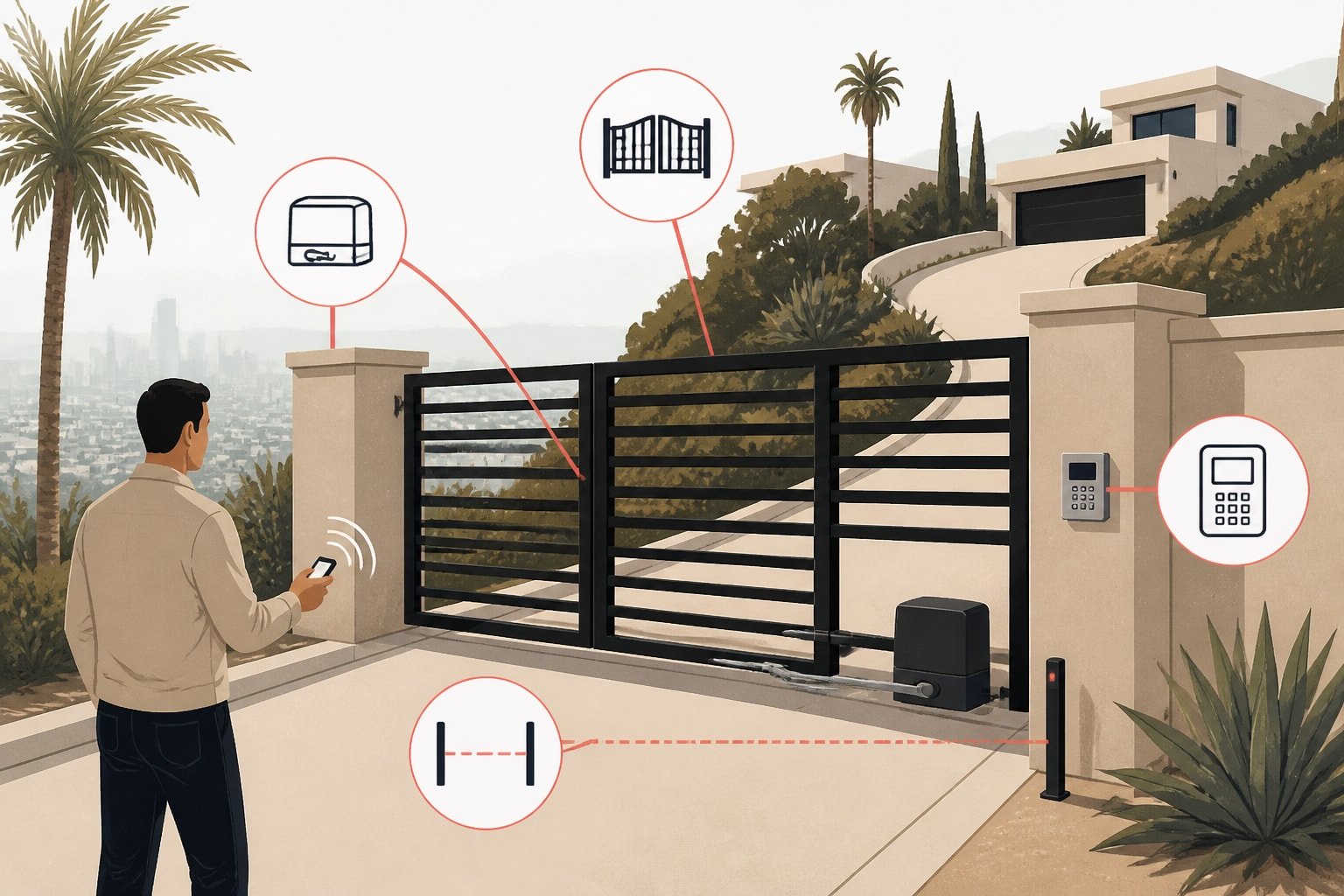

Custom electric gates are made-to-measure driveway or entry gates, built to your property's dimensions and style and powered by a motorized operator you control with a remote, keypad, intercom, or phone. For Los Angeles homeowners, the right choice depends on your driveway layout, slope, security needs, and the safety standards your installer must meet. This guide covers the main decisions so you can buy once and avoid avoidable repairs later.
What Makes an Electric Gate "Custom"?
A custom electric gate is designed around your property rather than selected from a fixed catalog size. The gate leaf, frame, materials, finish, and operator are all specified to fit your driveway width, grade, architecture, and usage patterns.
In practice, customization usually covers five areas:
- Dimensions: Width and height matched to the opening, including allowances for slopes common across the Hollywood Hills, Silver Lake, and Pasadena foothills.
- Materials: Steel, wrought iron, aluminum, wood, or composite panels, often combined.
- Design: Picket spacing, privacy panels, decorative scrollwork, arches, and address plaques.
- Operator and hardware: Motor type, power source, and mounting method chosen for the gate's weight and swing or slide path.
- Access and accessories: Keypads, intercoms, cameras, loop detectors, and smart-home integration.
One distinction matters before you shop. An electric gate is any gate moved by a motor. An automatic gate typically adds sensors and logic so it opens and closes with little input. Gates & Garage Door Express breaks down the difference between electric and automatic gates if you want to understand how those terms affect your configuration.
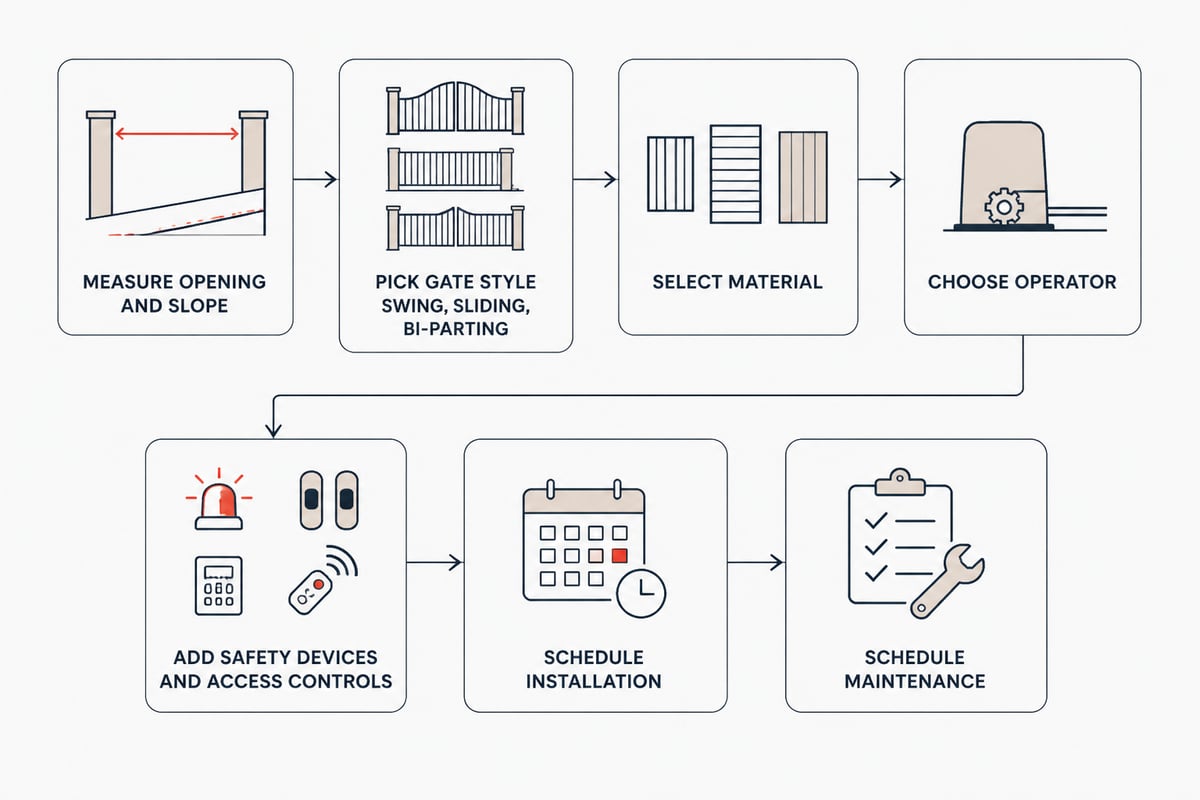
Which Gate Style Fits Your Los Angeles Property?
The best gate style depends mainly on how much clear space you have around the opening and how steep your driveway is. Swing gates need room to open, sliding gates need room alongside the opening, and bi-parting gates split the difference.
| Gate style | Space needed | Best suited to | Main consideration |
|---|---|---|---|
| Single swing | Clear arc inside or outside the opening | Narrow to moderate driveways with flat approach | Sloped driveways can limit the swing |
| Dual swing | Clear arc for two leaves | Wide driveways and formal entries | Two operators to maintain |
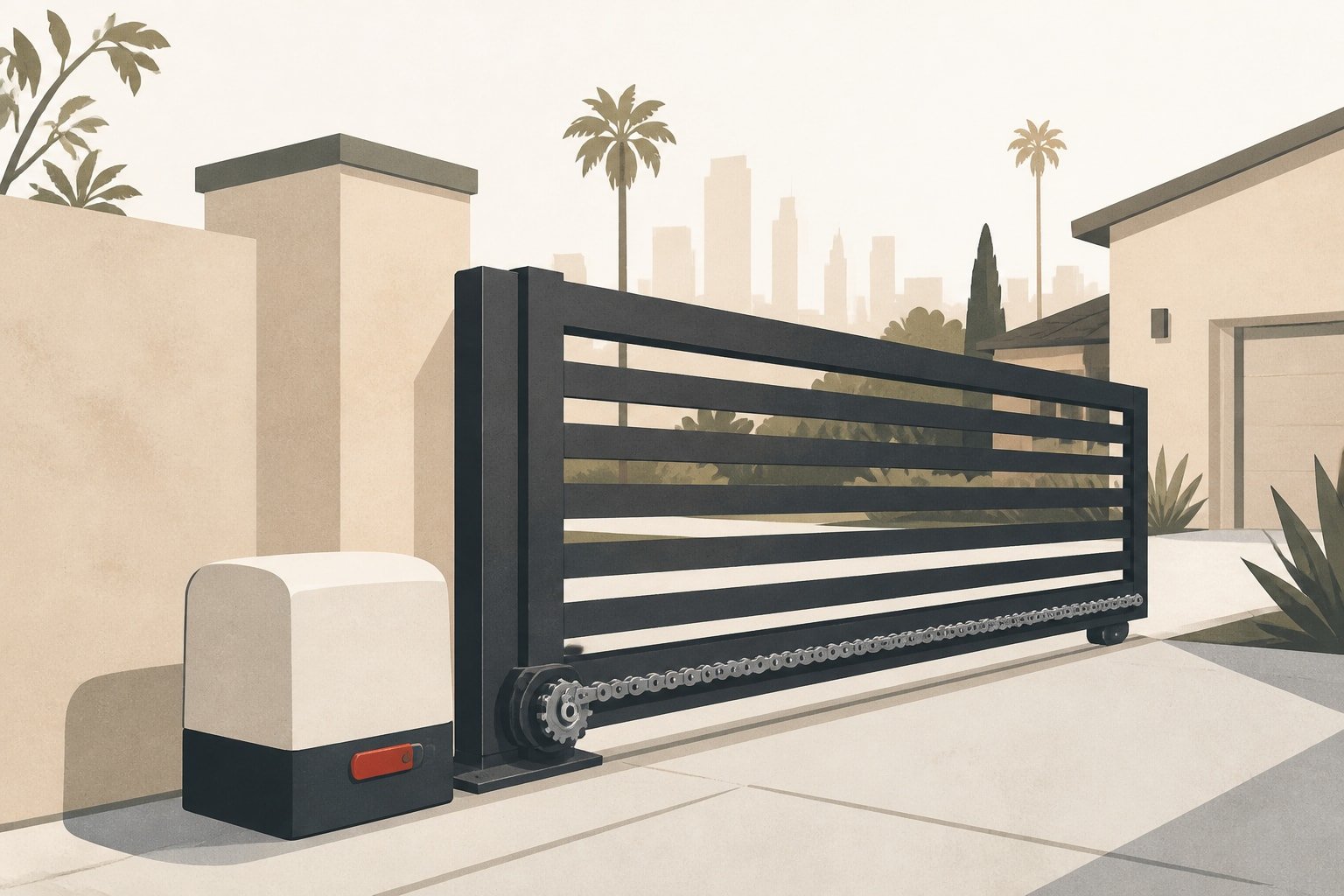
| Sliding | Straight run beside the opening, equal to gate width | Steep or short driveways, tight setbacks | Track must stay clear of debris |
| Bi-parting slide | Run on both sides, each half the opening | Wide openings with limited side space | More moving parts than a single slide |
Many Los Angeles lots sit on hillsides where a swing gate would hit the pavement as it opens. A sliding design avoids that problem, though it needs a level, clear path. If a slide is your likely choice, Gates & Garage Door Express covers the basics of electric sliding gates and the maintenance they require. Homeowners leaning toward swing designs can review how an electric swing gate opener works before committing to a layout.
For a fuller comparison of configurations, this walkthrough on what type of electric gate to buy in Los Angeles is a useful companion.
How Do You Choose the Right Gate Operator?
Choose the operator by gate weight, length, usage frequency, and available power, not by price alone. The operator is the motor and control unit that moves the gate, and an undersized one will wear out early.
Key factors to weigh:
- Gate weight and size. Solid steel or wood privacy gates weigh far more than open-picket aluminum. The operator's rated capacity should exceed your gate's weight with margin.
- Duty cycle. A household with several daily trips needs an operator built for frequent use.
- Power source. AC units draw from household wiring. DC and solar-assisted systems suit properties where trenching power to the gate is costly, and Southern California's sunshine makes solar a practical option.
- Battery backup. Power outages are a real concern in Los Angeles, so battery backup lets the gate open during a blackout, which also matters for emergency exit.
- Manual release. Every system should have a reliable way to open the gate by hand.
Underpowered operators are among the most common causes of the service calls homeowners place later. If you already have a gate and are considering upgrading its drive, this overview of whether to add a motor to your electric gate explains when conversion makes sense.
What Safety Standards Must a Compliant Gate Meet?
A compliant gate operator must be listed to UL 325, the safety standard that governs residential and commercial gate and door operators in the United States and Canada. ANSI/CAN/UL 325 sets minimum product-safety, testing, manufacturing, and installation requirements for these systems.
This is not an optional extra. The 2024 International Building, Residential, and Fire Codes, along with NFPA 1 and NFPA 101, require installed gate operators to be listed to UL 325. The U.S. Consumer Product Safety Commission also takes part in the UL standards panel responsible for the standard, as noted on its gate operator standards page.
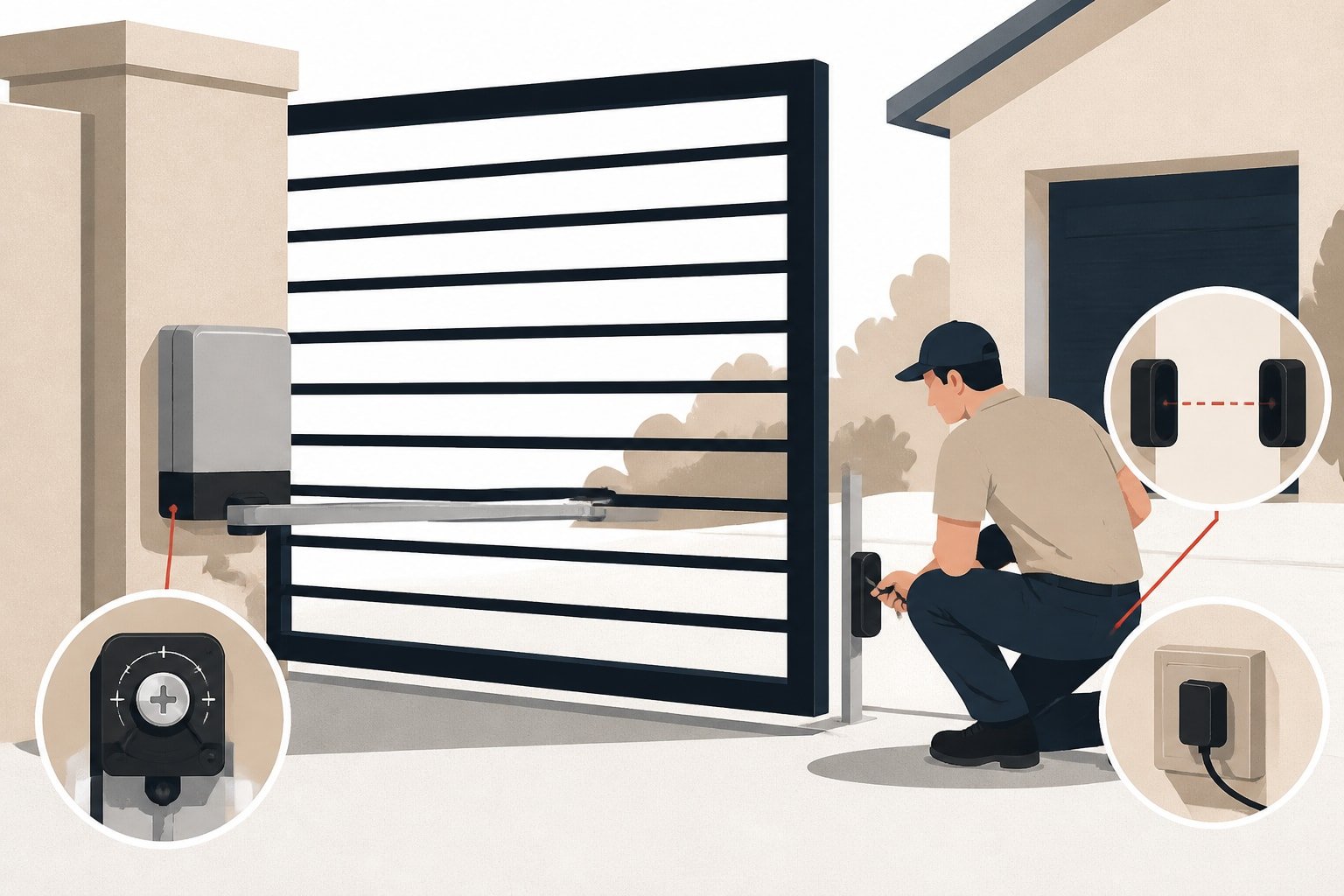
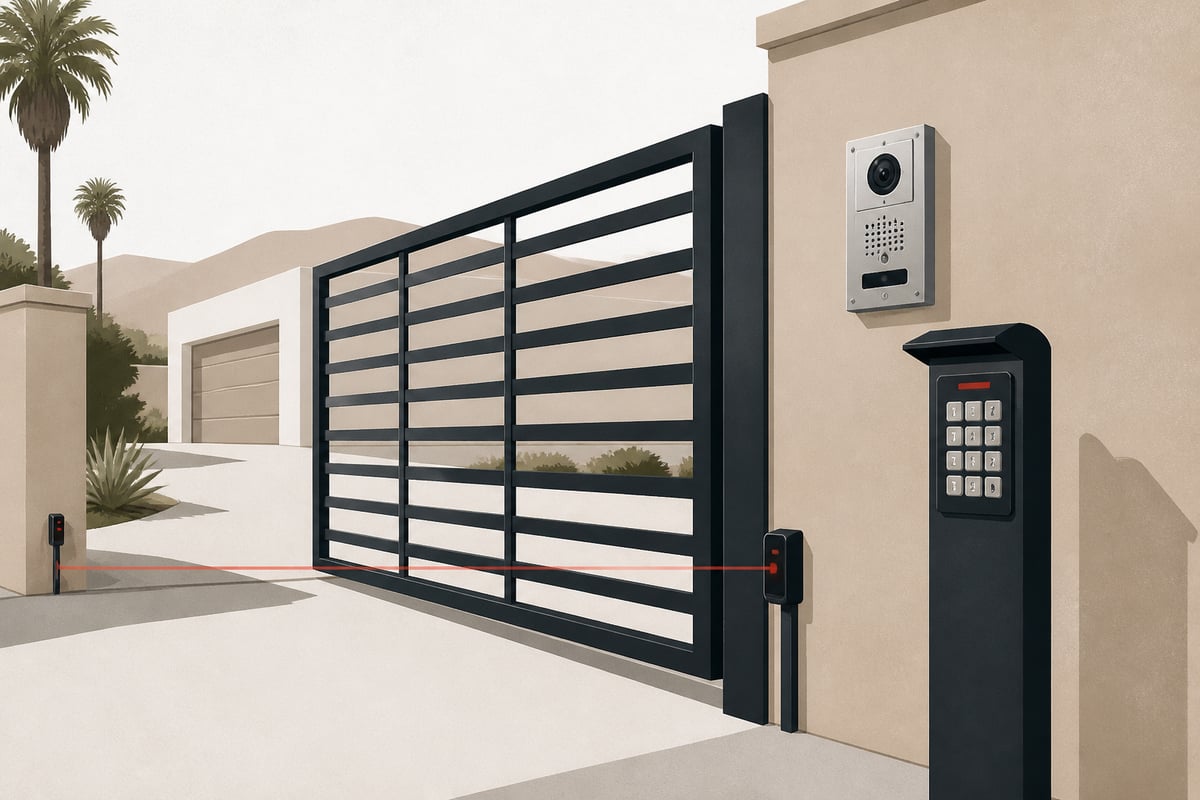
The most practical requirement for buyers involves entrapment protection. UL states that automated gate systems must have entrapment protection, and operators must monitor external devices such as photoelectric sensors or sensing edges. UL also explains external entrapment-protection devices in more detail.
When you review a quote, confirm these points in writing:
- The operator carries a UL 325 listing.
- Photo eyes or sensing edges cover each pinch or crush zone.
- The system monitors those devices and stops the gate if one fails.
- Vehicle and pedestrian paths are addressed separately.
If a bid is vague on any of these items, ask for clarification before signing.
Which Access Controls and Smart Features Are Worth Adding?
The access controls worth adding are those that match how your household and visitors actually arrive. Start with the basics, then add features that solve a real problem.
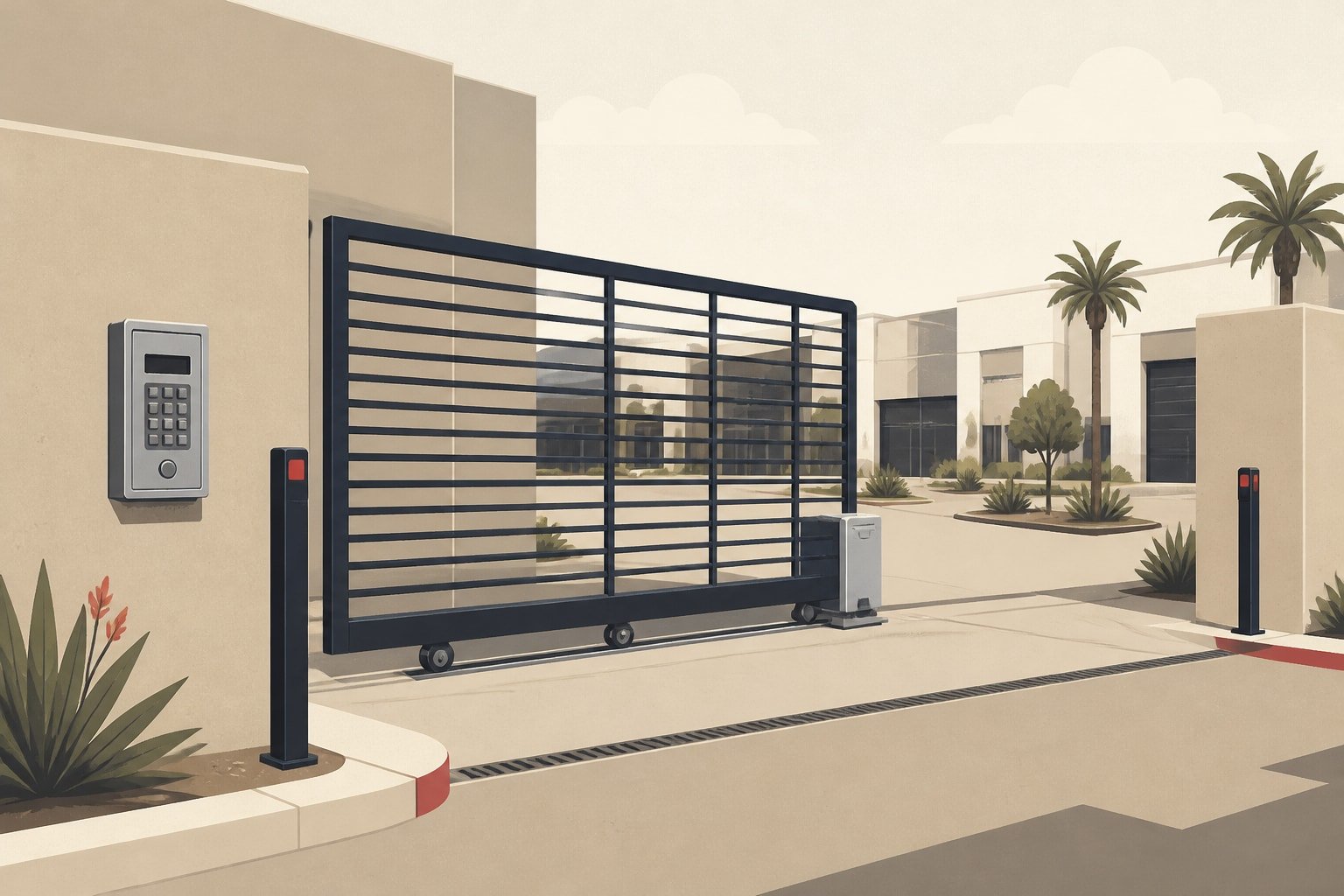
- Remote transmitters: The default for residents. Choose a system that lets you add and delete remotes without replacing the receiver. Gates & Garage Door Express explains options for an electric gate opener remote control.
- Keypads: Useful for guests, house cleaners, and contractors, since you can assign and revoke codes.
- Video intercoms: Let you screen visitors from your phone, which suits hillside homes where the gate sits far from the front door.
- Vehicle loop detectors: Buried sensors that open the gate for exiting cars and prevent closing on a vehicle.
- Smart-home integration: Phone control, scheduling, and activity logs.
- Emergency access: Fire department Knox-style access or siren sensors, where local requirements call for them.
More features mean more points of failure. Each added component should earn its place.
How Much Should Homeowners Plan to Budget?
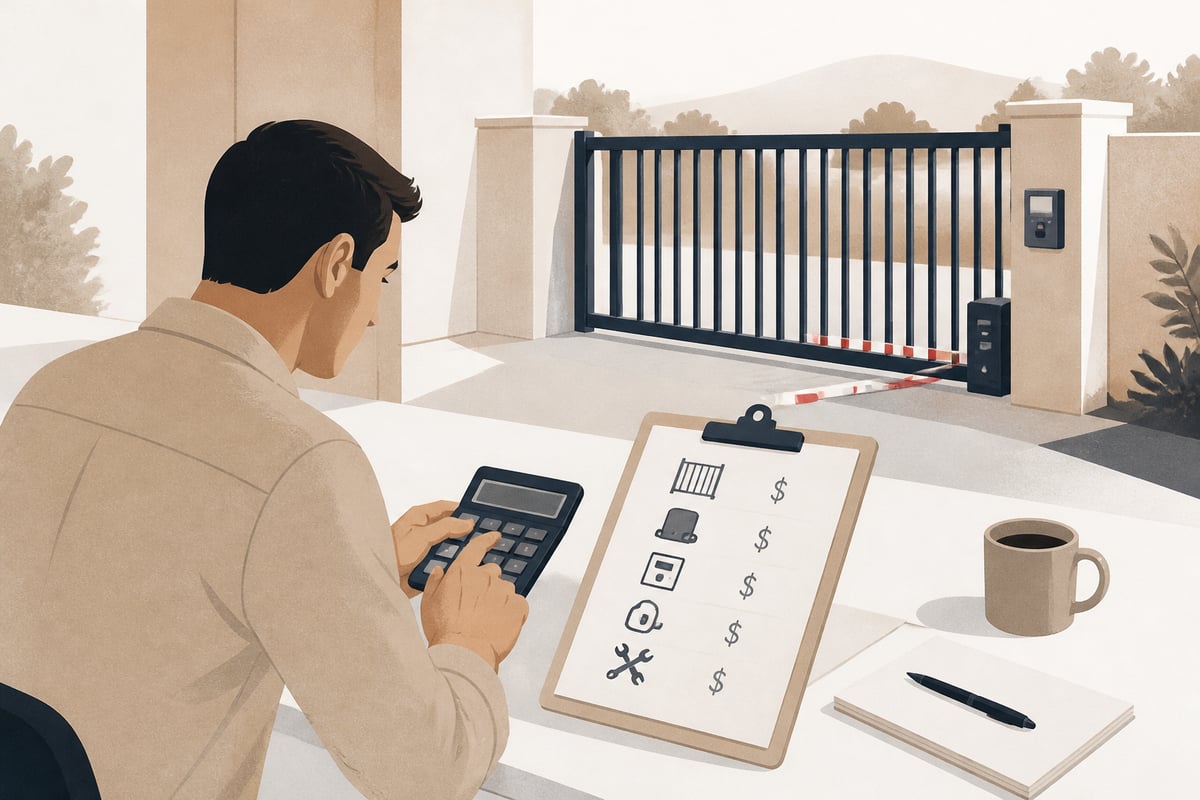
Budget varies widely, so get itemized written quotes rather than relying on a single number. Prices depend on gate size, material, custom fabrication, operator class, trenching and electrical work, permits, and the access technology you choose.
These are the main cost drivers:
- Fabrication and materials: Solid wood or ornate wrought iron costs more than a simple aluminum picket design.
- Site work: Concrete footings, trenching for power and communication lines, and slope grading add labor.
- Operator and safety hardware: Heavier-duty operators, battery backup, and additional sensors raise the price.
- Permits and inspections: Many Los Angeles-area jurisdictions require permits, and rules differ between the City of Los Angeles and neighboring municipalities.
- HOA or design review: Some neighborhoods require approval before fabrication begins.
Compare quotes line by line. A lower bid that omits sensors, backup power, or permit handling is not truly lower.
What Should You Check Before Hiring an Installer?
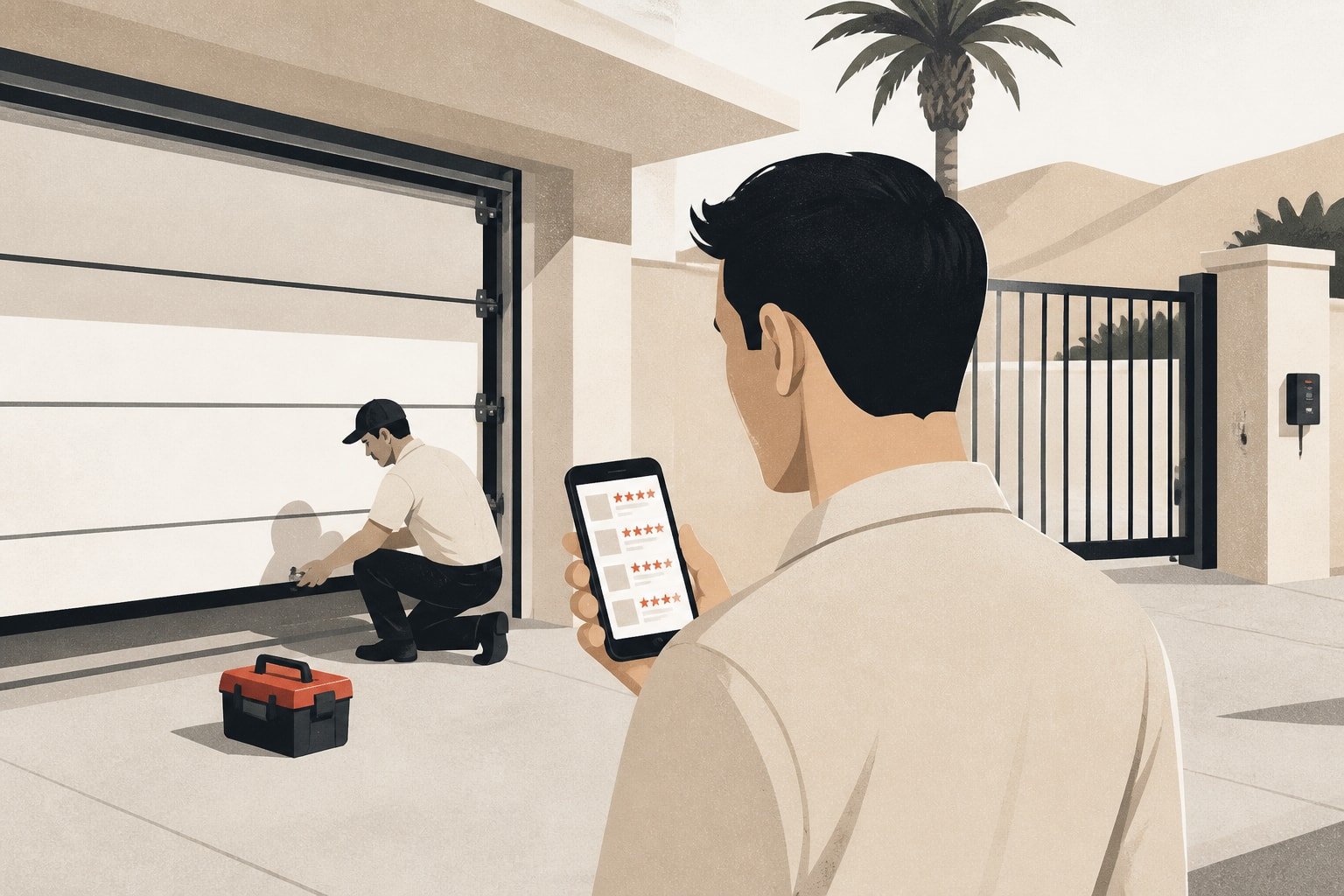
Verify the contractor's license, insurance, brand experience, and service availability before you sign. A beautiful gate still depends on competent installation and reliable follow-up service.
Use this checklist:
- License status. Confirm an active license through the Contractors State License Board and match it to the business name on the quote.
- Insurance. Ask for proof of liability coverage and workers' compensation.
- UL 325 compliance. Request the operator model number and confirm its listing.
- Brand familiarity. Installers who work on all major operator brands can service your system even if the original installer is unavailable.
- Warranty terms. Get coverage details for both fabrication and operator in writing.
- Post-install support. Ask what happens when something fails at 9 p.m. on a Friday.
That last question matters more than it seems. Gates fail at inconvenient times, and a locked-in car or a gate stuck open overnight is a security problem, not just an annoyance.
How Do You Protect a Custom Gate After Installation?
Protect your investment with scheduled maintenance, a few simple monthly checks, and a repair provider you can reach quickly. Custom hardware is costly to replace, and most failures begin as minor wear that goes unaddressed.
A simple routine helps:
- Monthly: Watch a full open-and-close cycle. Listen for grinding or hesitation, and look for rubbing or drifting.
- Quarterly: Wipe photo-eye lenses, clear debris from tracks, and test the manual release.
- Annually: Schedule a professional inspection of the operator, limit settings, sensors, hinges or rollers, and battery backup.
If your gate stops responding, run through the basics first. Gates & Garage Door Express outlines how to check your electric gate before calling a technician, which can rule out a dead remote battery, a tripped breaker, or a blocked sensor.
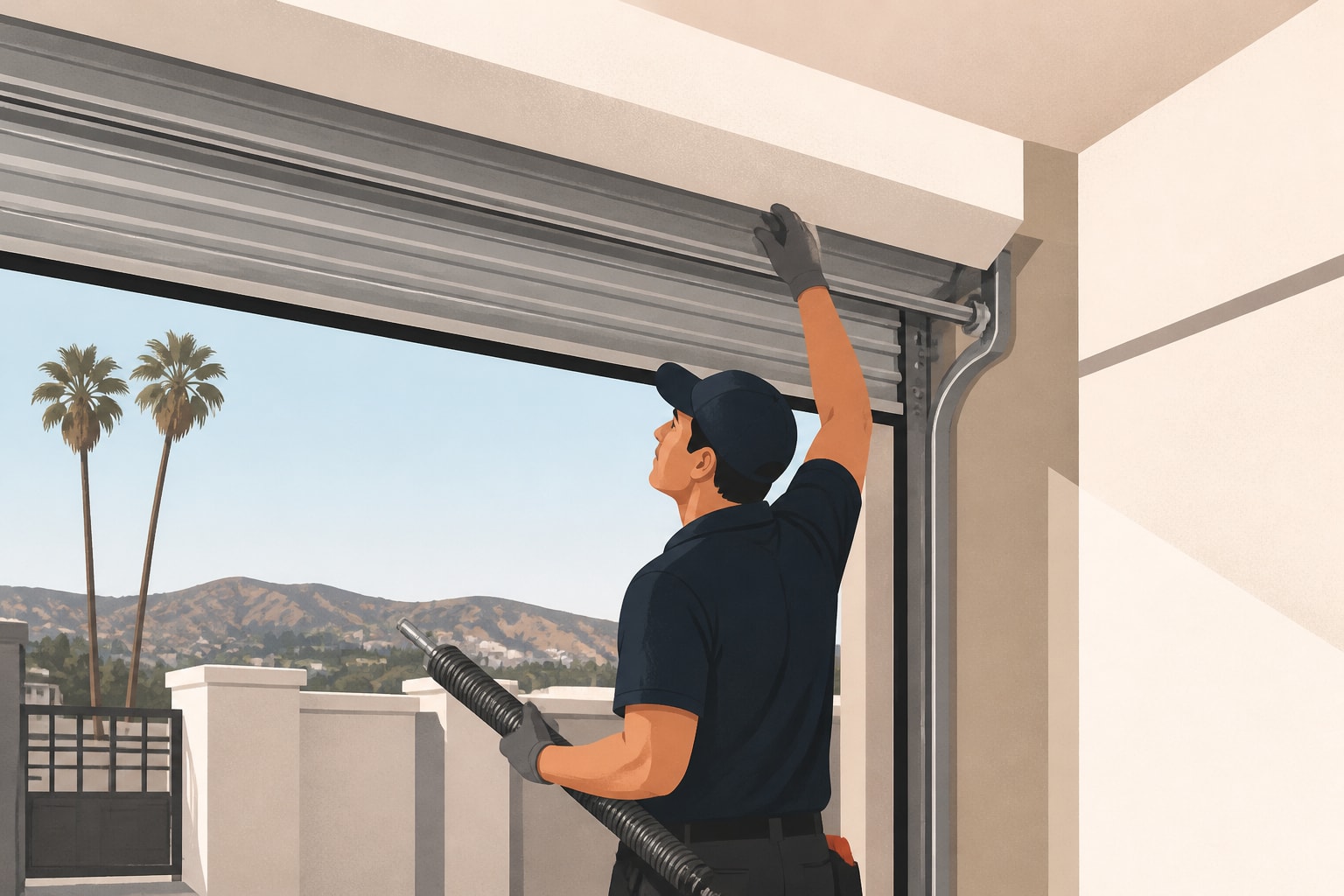
For repairs, Gates & Garage Door Express offers electric gate repair across Los Angeles County. The family-owned company has years of experience, is licensed and insured, works on all major gate and garage door brands, and provides same-day, on-site service. Emergency service is available, including after hours. That matters if your custom gate fails while your car is trapped inside or your driveway is left open.
Frequently Asked Questions
How long does it take to get custom electric gates?
Timelines depend on design complexity, fabrication, permits, and any HOA review. Simple designs move faster than ornate or oversized ones. Ask your installer for a schedule that separates approval, fabrication, and installation phases.
Can my existing gate be converted to electric?
Often yes, if the gate is structurally sound, properly hung, and balanced. A heavy, warped, or poorly aligned gate may need repair or rebuilding before a motor is added, since the operator will not correct mechanical problems.
Do I need a permit?
Many Los Angeles County jurisdictions require permits for gates and electrical work, and requirements vary by city. Your installer should know local rules and tell you who handles the application.
What happens during a power outage?
With battery backup, the gate keeps operating for a limited number of cycles. Without it, you will need to use the manual release. Confirm which applies to your system before installation.
Who should I call when my gate stops working?
Call a licensed technician who can reach you the same day and work on your operator brand. Avoid forcing the gate by hand if it is binding or off its track, since that can damage the operator and create a safety hazard.
Before you finalize a design, write down your driveway width, slope, and the operator brand on any existing gate, since those details shape every quote you will receive. If you already have a gate that has stopped working or want a technician to evaluate it before you invest in something new, Gates & Garage Door Express Inc. is a family-owned Los Angeles business that offers same-day service, so Call (818) 873-7687 to describe the problem and get a technician on the way.