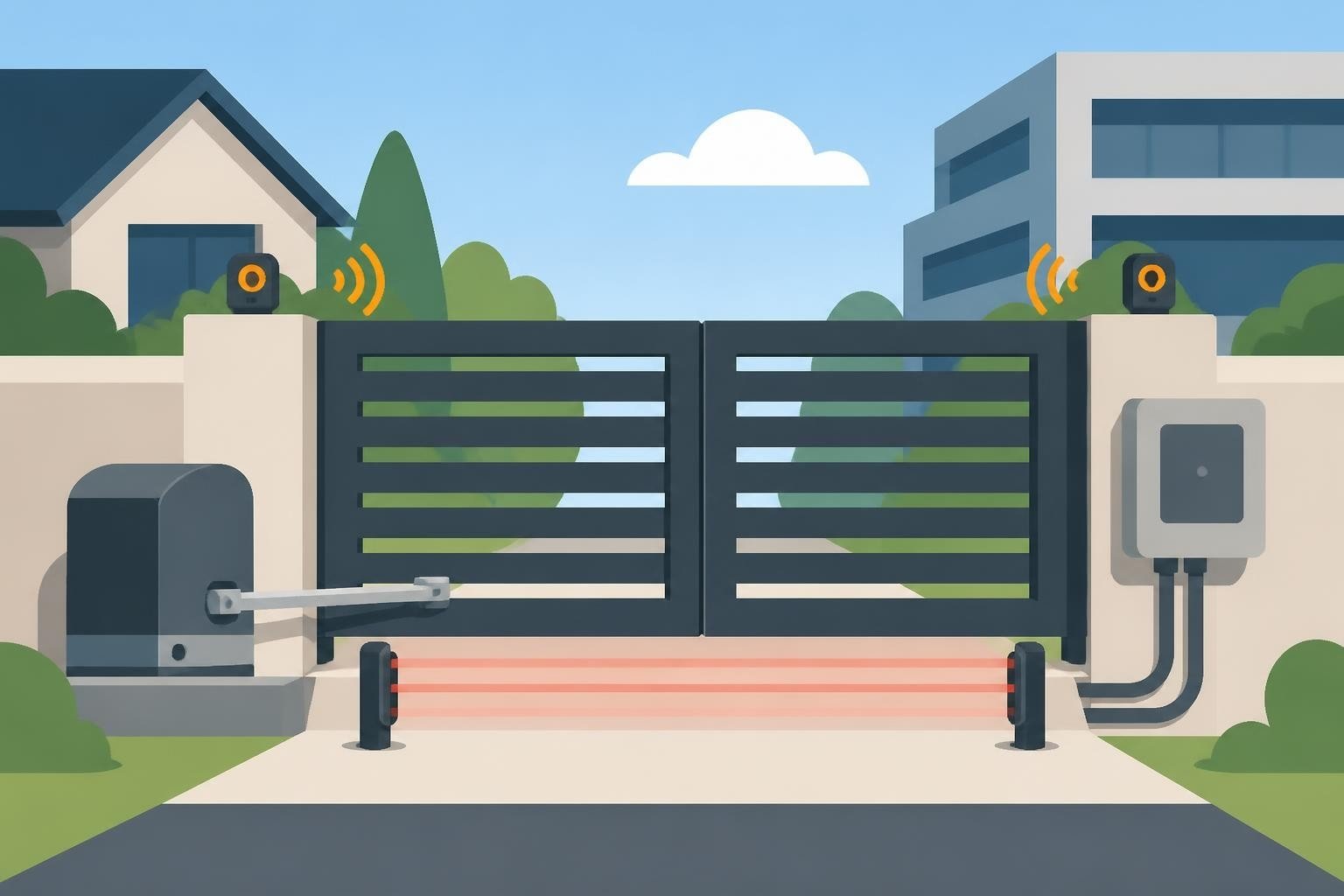
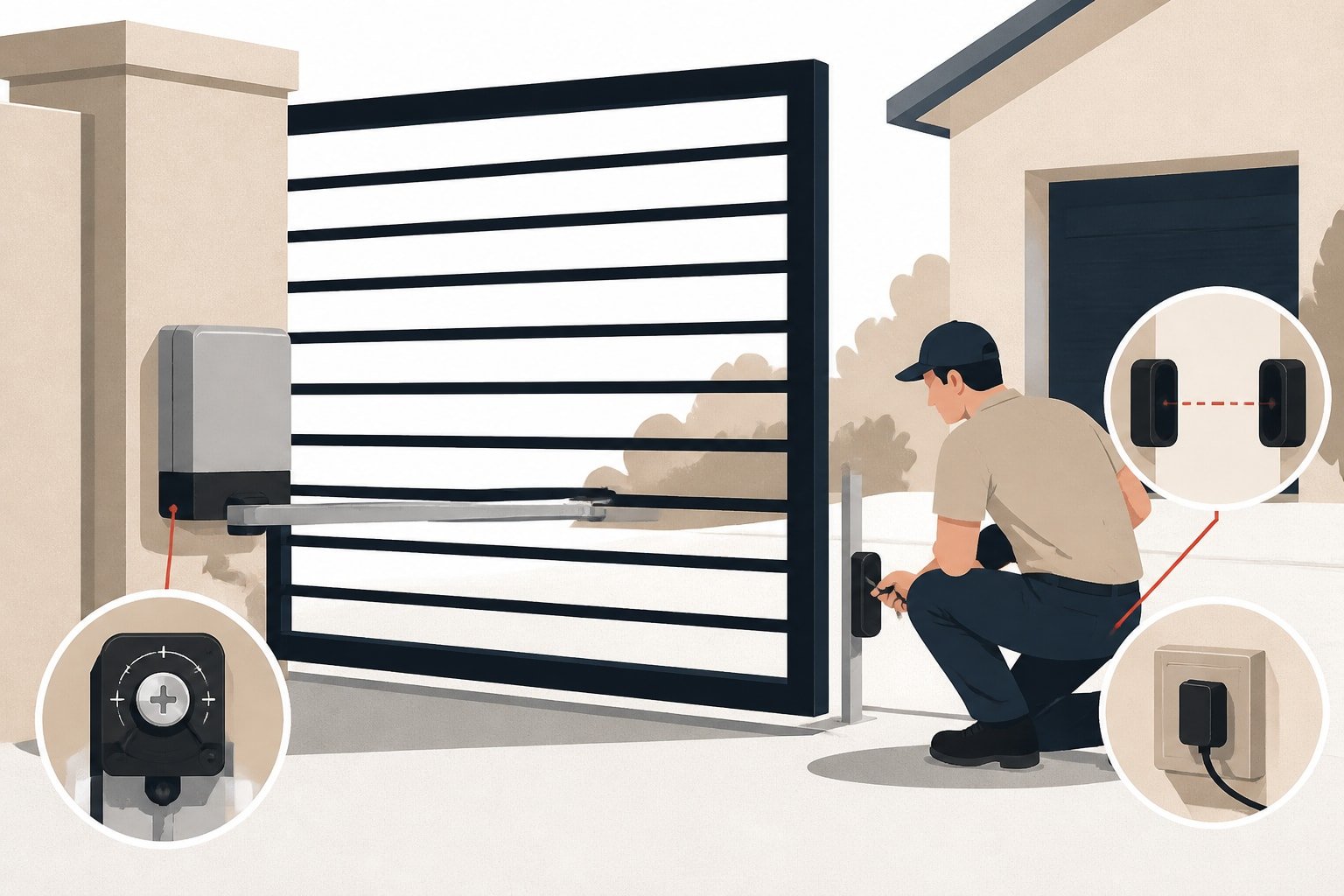

A LiftMaster gate opener is a motorized operator that opens and closes a swing, slide, or barrier gate through a control board, a drive motor, safety sensors, and a remote or keypad. Most problems come down to three areas: power, travel limits, and safety devices, and most can be diagnosed in under an hour once you know where to look.
This guide covers how these operators are matched to gates, how setup and adjustment work, how to troubleshoot a gate that has stopped responding, and what repairs and installation tend to cost. It is written for Los Angeles County homeowners and for property managers who rely on dependable access control.
How a LiftMaster Gate Opener Works
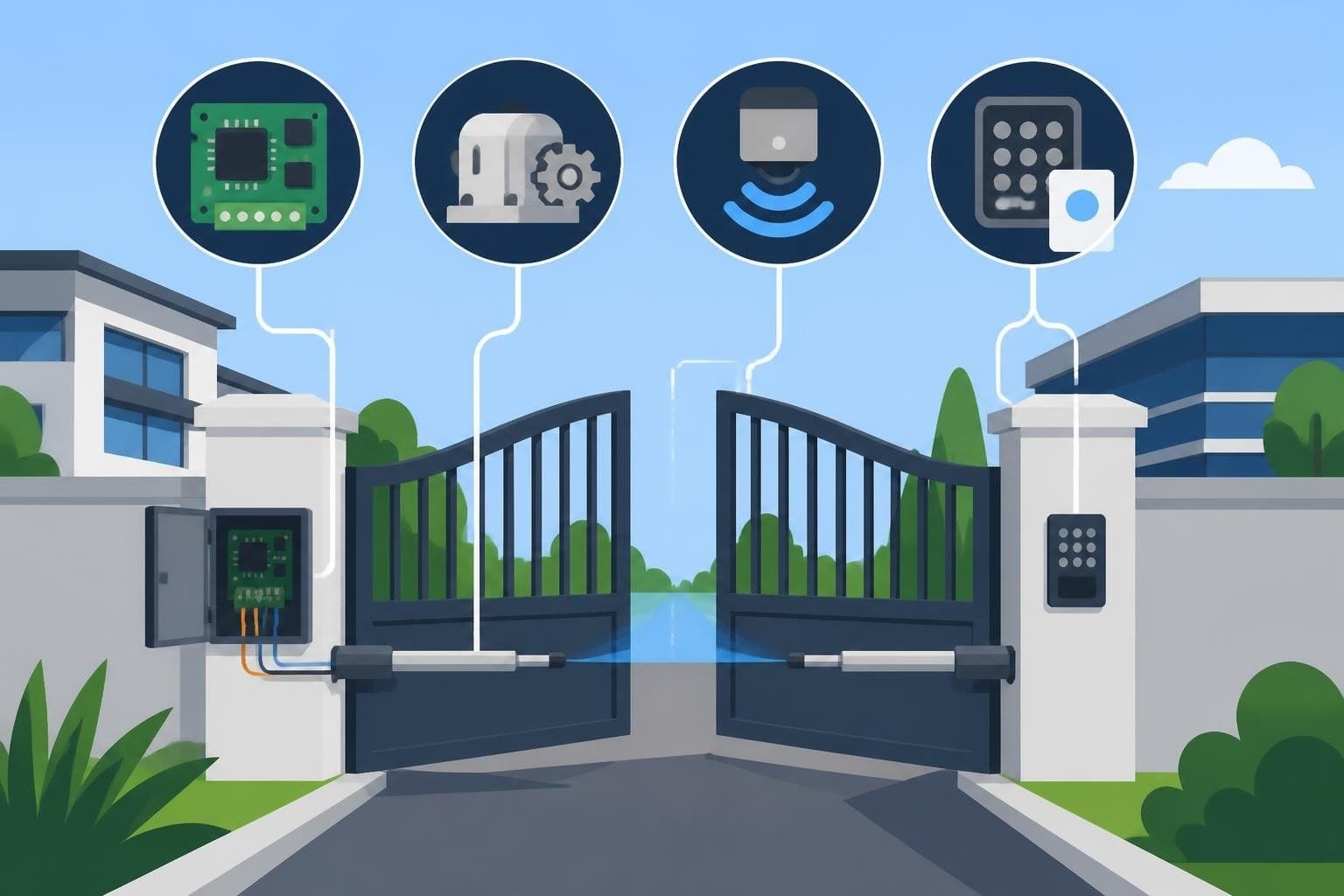
A LiftMaster gate opener combines four core components that must work together: a drive unit, a control board, safety devices, and access controls.
- Drive unit: A motor with an arm (swing gates), a chain or rack-and-pinion system (slide gates), or a barrel arm (barrier gates).
- Control board: Receives signals from remotes and keypads, manages travel limits, and monitors safety inputs.
- Safety devices: Photo eyes, edge sensors, and loop detectors that stop or reverse the gate when something is in its path.
- Access controls: Remotes, keypads, intercoms, and smartphone-connected accessories.
Residential models are built around the gate type. Swing operators suit driveway gates with hinges, while slide operators suit gates that travel along a track or cantilever frame. For a closer look at these categories, see this overview of a LiftMaster electric gate opener and the broader range of powered gate openers.
Commercial properties have different demands. Apartment complexes, warehouses, and office parks typically need higher cycle ratings and tighter integration with access control, which is where a commercial gate opener specification matters.
Choosing the Right Operator for Your Gate
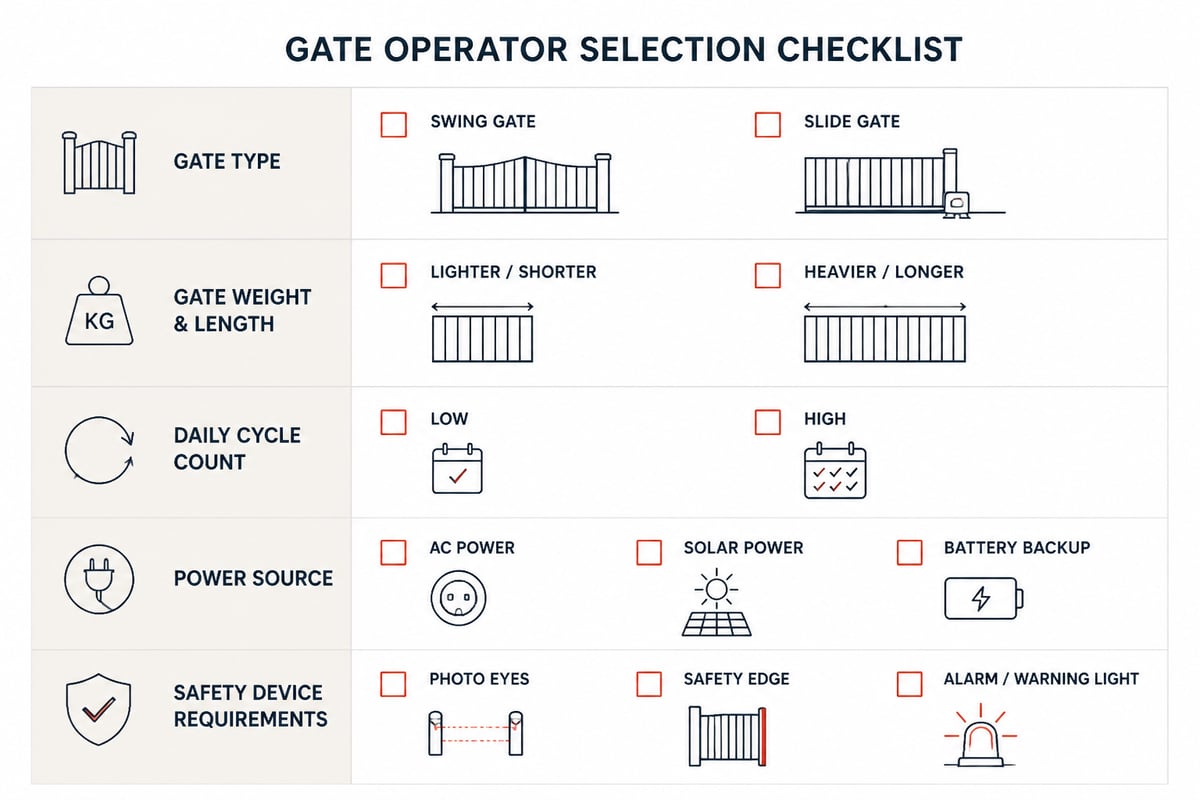
The right operator depends on gate type, weight, length, usage frequency, and available power.
Start with these questions:
- Does the gate swing or slide? This determines the operator family.
- How heavy and how long is the gate? Operators are rated for maximum weight and length. Exceeding either shortens motor life and causes nuisance stops.
- How many cycles per day? A single-family driveway differs sharply from a property with dozens of daily entries.
- Is AC power nearby? If not, solar-assisted or battery-backed options become relevant.
- Is a battery backup needed? Los Angeles power interruptions and Public Safety Power Shutoffs make backup power a practical consideration.
Gate condition matters as much as the operator. A gate that sags, drags, or binds will overload any motor. Before blaming the opener, confirm the gate swings or rolls freely by hand with the operator disengaged.
LiftMaster Gate Opener Setup Basics
Proper setup follows a fixed order: mount the operator, connect power, set travel limits, program accessories, and install safety devices before putting the gate into service.
Mounting and Power
Mount the operator on a rigid post or pad, since flex in the mounting point can cause inconsistent limits and wear. Keep low-voltage control wiring separated from high-voltage power, and use a dedicated circuit with proper grounding. Pay attention to conduit routing in LA's mix of older and newer properties, where existing wiring is often undersized or damaged by moisture.
Setting Limits and Force
Travel limits tell the operator where open and closed positions are. Force settings determine how much resistance the operator tolerates before it stops or reverses. Set force as low as the gate allows while still completing a full cycle. High force settings can mask a mechanical problem and increase the risk of injury.
Programming Remotes and Keypads
Most control boards have a learn button that pairs a remote or keypad transmitter. Clear old codes when a property changes hands or a tenant leaves, since lost remotes are a real access control risk. If you need more handheld transmitters, a remote gate opener is typically a quick add.
Safety Devices Are Not Optional
Safety hardware is essential, not optional. LiftMaster states that slide gate operators require at least two external monitored safety devices, one for the open direction and one for the close direction, to meet its stated UL 325 requirements. The same page notes that its slide-gate operators began requiring these devices on August 1, 2018, so any older slide installation lacking them deserves a professional review.
How Do I Adjust a LiftMaster Gate?
To adjust a LiftMaster gate, disengage the operator, confirm the gate moves freely by hand, then reset the travel limits and force settings on the control board following the model's manual.
The general sequence works like this:
- Disconnect power and release the operator so the gate can be moved manually.
- Check the mechanical condition. Look for sagging hinges, worn rollers, debris in the track, or a bent arm.
- Re-engage the operator and restore power.
- Reset the open and closed limits using the board's limit adjustment procedure or the limit settings shown in your manual.
- Adjust force settings in small increments, testing a full open and close cycle after each change.
- Test the safety devices by blocking the photo eye or triggering the edge sensor during travel.
Adjustment procedures differ between swing, slide, and barrier models, so use the model number on the operator to find the correct manual. If the gate stops short of its limit repeatedly after adjustment, the problem is usually mechanical rather than electronic.
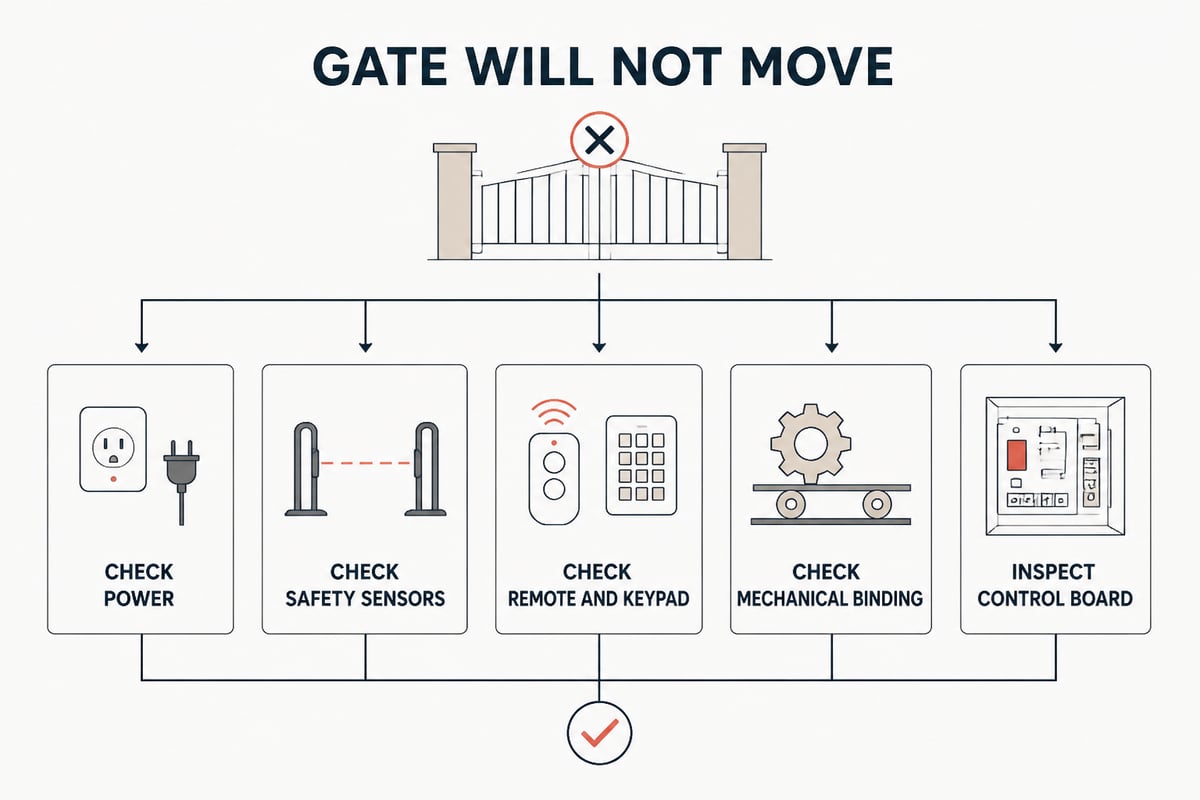
How to Troubleshoot a Gate Opener
To troubleshoot a gate opener, check power first, then safety devices, then the remote or keypad, then mechanical binding, and finally the control board.
This order saves time because the simplest causes are also the most common.
| Symptom | Likely Cause | First Check |
|---|---|---|
| No response, no lights | No power or tripped breaker | Breaker, outlet, transformer |
| Remote does nothing, keypad works | Dead remote battery or lost programming | Replace battery, re-pair remote |
| Gate starts then reverses | Safety sensor blocked or misaligned | Clean and realign photo eyes |
| Gate stops partway | Limit setting or mechanical drag | Hand-test gate, review limits |
| Motor hums, gate won't move | Failed capacitor or jammed drive | Disengage and test by hand |
| Gate opens but won't close | Close-direction safety input open | Inspect close-side sensors |
| Intermittent operation | Loose wiring or weak backup battery | Check terminals, test battery |
Common Culprits in Los Angeles
Local conditions create their own patterns. Sun exposure fades and cracks plastic housings and sensor lenses. Coastal moisture corrodes terminals and connectors. Landscaping growth, spider webs, and dust regularly block photo eyes. Rodents and ants also nest in control boxes more often than owners expect.
Battery Backup Problems
If your gate works on power but fails during an outage, the backup batteries are the first suspect. Weak batteries can also cause odd behavior during normal operation, such as slow travel or resets. Replace backup batteries on a regular schedule rather than waiting for failure.
Are LiftMaster Gate Openers Any Good?
LiftMaster gate openers are widely regarded as dependable, and their reputation rests on broad model coverage, accessible parts, and compatibility with common access control accessories.
Several practical strengths stand out:
- Range of models covering residential swing and slide gates through heavy-duty commercial barrier operators.
- Accessory ecosystem including keypads, intercoms, photo eyes, and loop detectors that integrate with the control board.
- Parts availability that keeps older units serviceable well beyond their first decade.
- Safety compliance built around UL 325 requirements.
The honest caveat is that even a well-built operator fails early when it is mismatched to the gate, installed on a weak post, or run without safety devices. Reliability is as much about installation quality and maintenance as it is about the brand. A technician who works on all major gate brands can also tell you when repair makes sense and when replacement is the better value.
What Does Gate Opener Installation and Repair Cost?
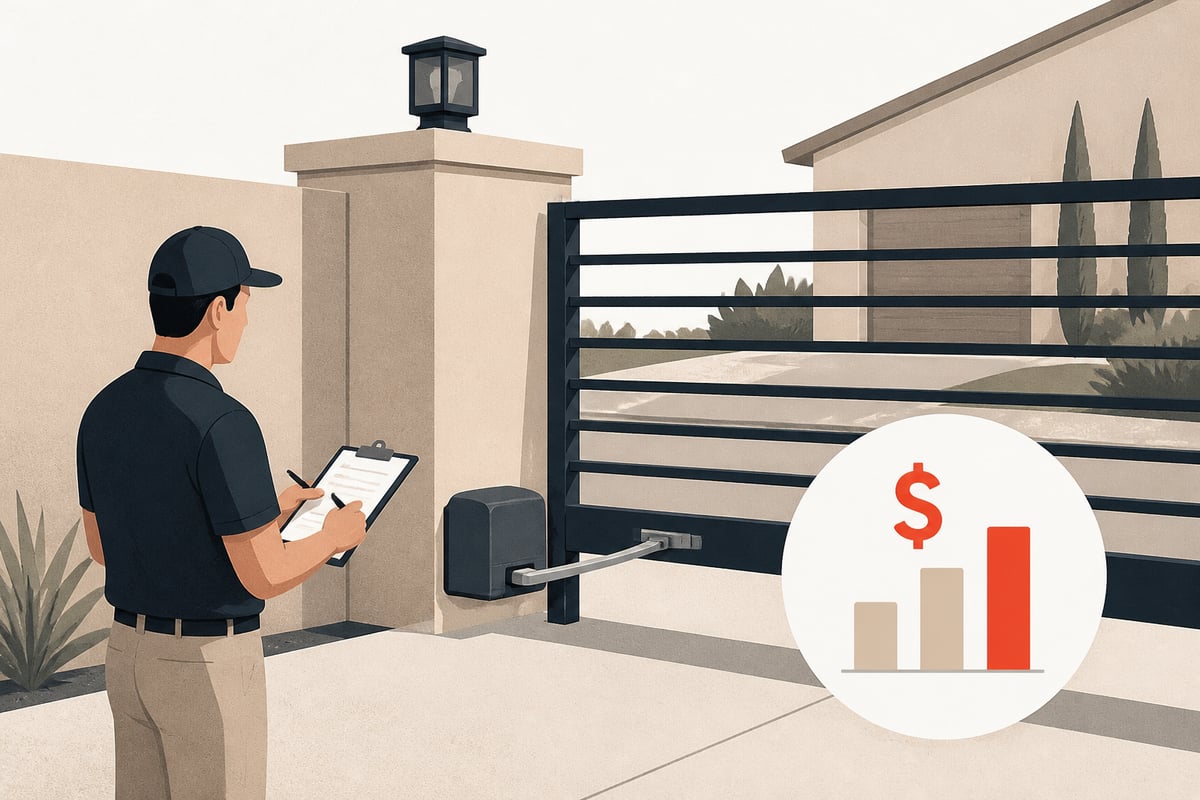
Cost depends on gate type, operator model, gate condition, wiring needs, and whether you are repairing or replacing, so a site visit is the only way to price a job accurately.
Instead of quoting figures that vary widely across Southern California, here are the factors that move the price most:
- New installation versus replacement: Swapping an operator on an existing, well-aligned gate costs less than a first-time installation requiring trenching and electrical work.
- Gate size and weight: Heavier or longer gates need higher-rated operators.
- Electrical work: New circuits, conduit runs, and grounding add labor.
- Safety and access accessories: Photo eyes, edge sensors, keypads, and intercoms add to the total.
- Repair scope: A replaced capacitor or sensor is a very different job from a failed control board or motor.
For help understanding what drives pricing, review this page on automatic gate price. If you are planning a new installation, the process is outlined under automatic gate opener installation. A written estimate before work begins is the standard to expect.
Repair or Replace: Making the Call
Repair makes sense when the gate is mechanically sound and the failed part is a discrete component; replacement makes sense when the operator is obsolete, repeatedly failing, or undersized for the gate.
Consider replacement when:
- The control board and motor have both failed within a short period.
- Replacement parts for your model are no longer available.
- The operator was never rated for your gate's weight or usage.
- The unit lacks current safety device support.
Consider repair when the symptoms are isolated, such as a worn remote receiver, a failed sensor, or a misadjusted limit. For electrical and motor faults, professional electric gate repair in Los Angeles can identify whether a component swap will restore reliable service.
Maintenance That Prevents Most Failures
A short, regular maintenance routine prevents the majority of service calls, and most of it takes only minutes.
- Monthly: Wipe photo eye lenses, clear debris from tracks, and test the gate's auto-reverse by placing an obstruction in its path.
- Quarterly: Lubricate hinges, rollers, and chain as the manufacturer directs, and inspect arms and brackets for looseness.
- Twice a year: Check wiring connections for corrosion, confirm the operator is firmly mounted, and test the manual release.
- Annually: Replace backup batteries if they are aging, and have a technician verify force settings and safety devices.
Property managers should keep a simple log of tests and service visits. Documented maintenance supports safety compliance and helps identify gates that fail repeatedly, which are good candidates for upgrades or replacement.
If you are also reviewing your property's other access points, garage door openers share many of the same safety and maintenance principles. Local support for garage door opener repair covers the same sensor alignment and force-adjustment concepts.
Working With a Gate Service Provider in Los Angeles County
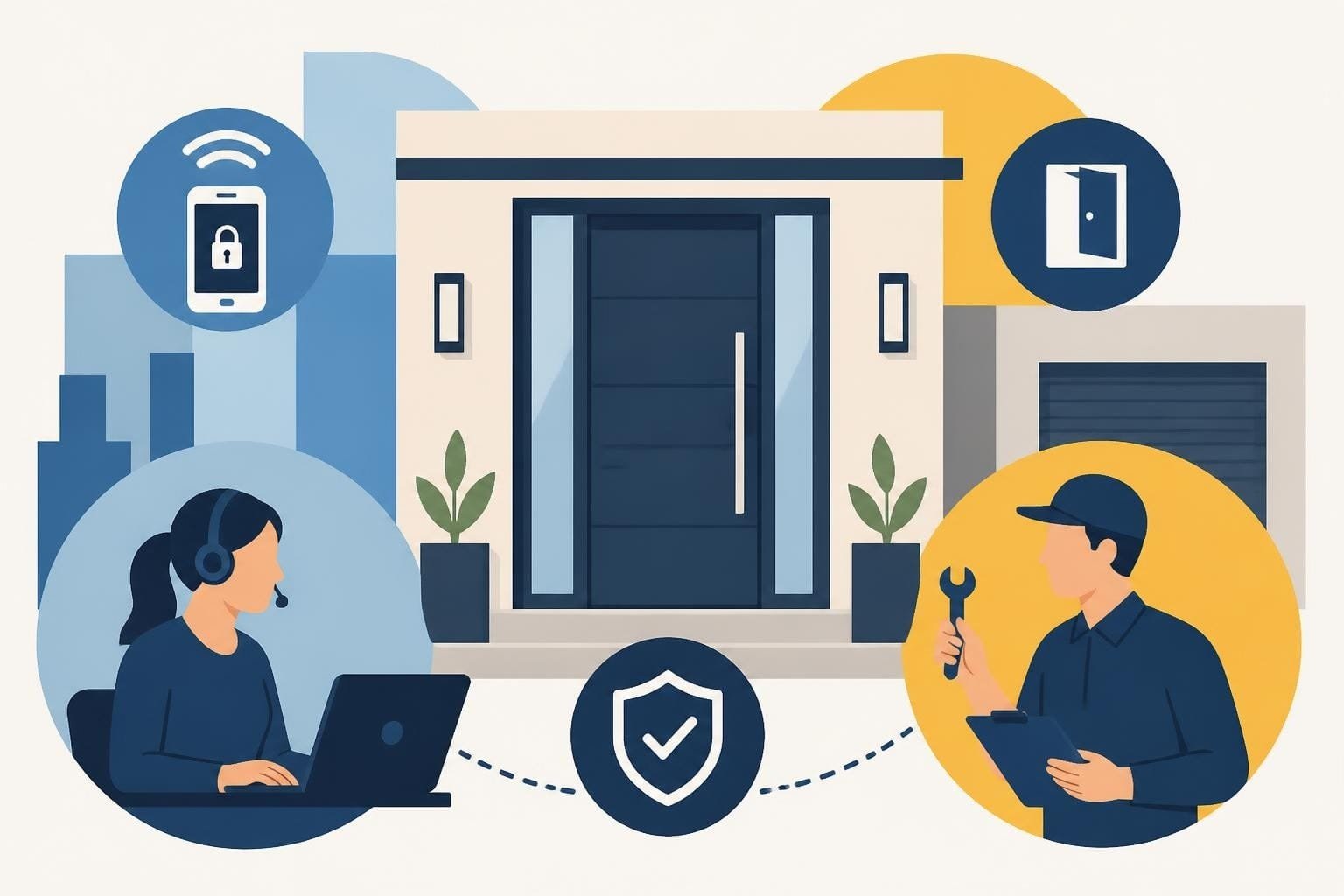
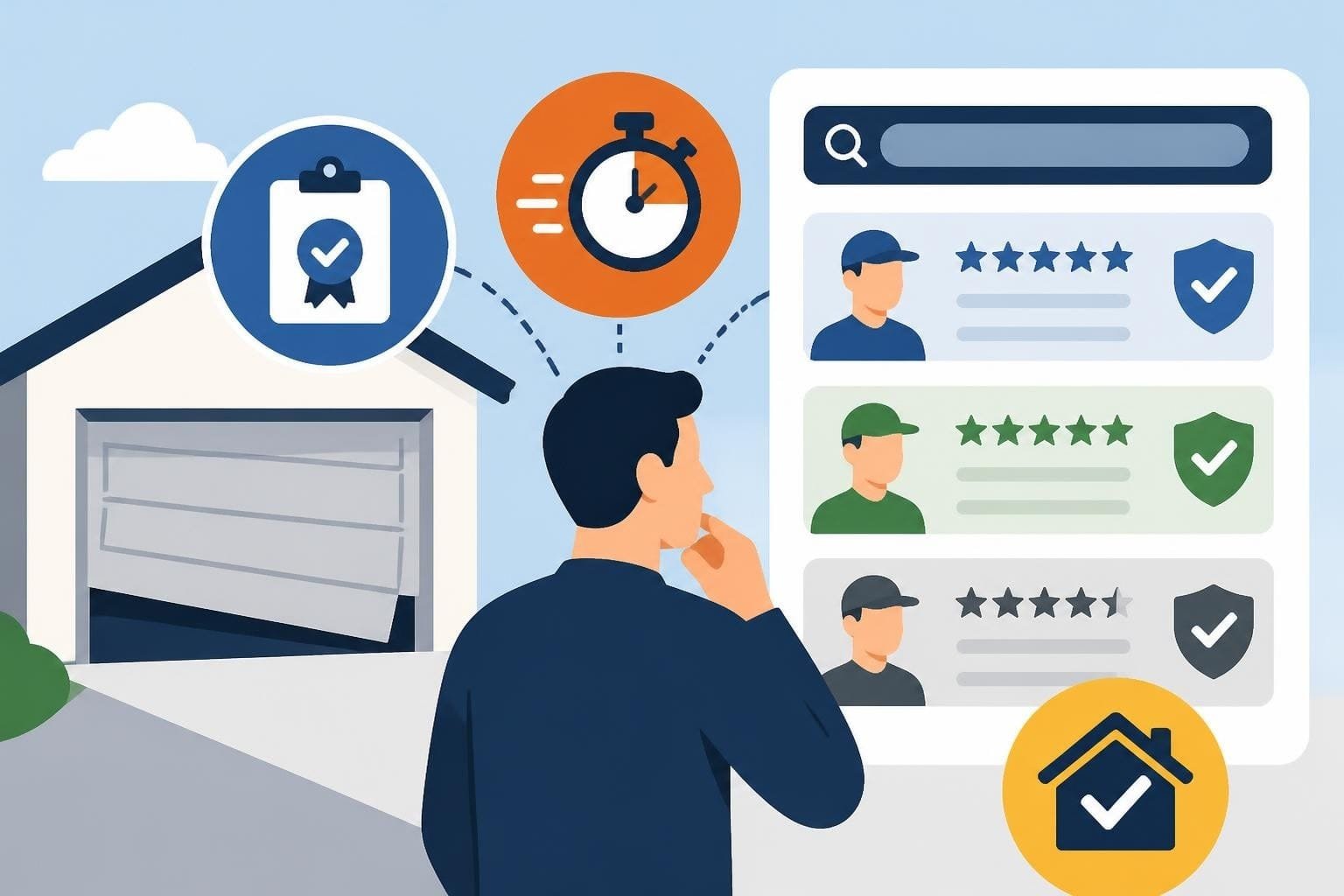
A reliable service provider should be licensed, insured, experienced across brands, and able to respond quickly when a gate failure leaves a property unsecured.
Gates & Garage Door Express Inc. is a family-owned company with 21 years in business, specializing in automatic gate and garage door repair in Los Angeles, CA. The team offers same-day emergency service, and with over 500 reviews on major accredited sites, you can read customer testimonials before you call.
FAQ
How long does a LiftMaster gate opener typically last?
Service life depends on usage, climate exposure, gate condition, and maintenance. A properly matched operator that receives regular upkeep often lasts many years, while an overloaded or neglected unit can fail much sooner.
Can I use a smartphone to control my gate?
Many modern operators support connected accessories that allow smartphone control, notifications, and guest access. Compatibility depends on your specific model, so confirm it before purchasing accessories. A look at available smart gates options can help you compare features.
Is it safe to bypass a safety sensor that keeps stopping my gate?
No. A sensor that keeps triggering is signaling a misalignment, obstruction, or fault, and bypassing it removes the protection that prevents injuries and property damage. Have the sensor cleaned, realigned, or replaced instead.
If your gate has stopped responding, start today by checking the breaker, cleaning the photo eye lenses, and testing the gate by hand with the operator disengaged. If it still will not run, Gates & Garage Door Express Inc. can send a technician for same-day service in Los Angeles, and its electric gate repair team handles everything from sensor faults to failed control boards. Call (818) 873-7687 to schedule a repair or request an estimate for your gate.